

 By
Train Your Cat to Sit: 6 Simple Tricks Every Owner Should Know
Introduction
Teaching your cat basic commands can be a fun and rewarding experience. Although cats are often considered independent pets, they can learn useful behaviors through patience, consistency, and positive reinforcement. One of the easiest commands to teach is sitting, which can help improve communication between you and your feline companion.
If you want to understand how to train a cat to sit, the key is to make learning enjoyable instead of stressful. Cats respond well to rewards, especially when they receive a favorite treat immediately after performing the desired action. Short training sessions can help your cat stay interested and gradually understand what you expect.
In this guide, you will discover practical techniques for teaching your cat to sit, choosing the right rewards, and introducing simple commands. You will also learn three effective tricks to train your cat and build a foundation for more advanced training in the future or how to train a cat to sit.
Whether you have a playful kitten or an adult cat, you can begin with simple exercises that match your pet’s personality and comfort level or Train Your Cat to Sit.
How to Train a Cat to Sit: Understand the Basics
Before starting a training session, it is important to understand how cats learn. Cats are more likely to repeat behaviors that lead to pleasant experiences. This is why positive reinforcement is one of the most effective approaches when learning how to train a cat to sit.
Instead of pushing your cat into position or repeatedly giving commands, encourage the behavior naturally and reward success.
Why Should You Teach Your Cat to Sit?
Teaching your cat to sit offers several benefits. First, it encourages your pet to focus on you for short periods. This can make other training activities easier later.
Second, a sitting command can be useful during everyday routines. For example, you can encourage your cat to sit before receiving a treat or starting a play session. This creates a predictable interaction and helps your cat learn that calm behavior can lead to rewards.
Third, training provides mental stimulation. Cats need opportunities to explore, play, and solve simple problems. Learning a command gives them another way to use their natural curiosity or Train Your Cat to Sit.
However, sitting is not a substitute for proper veterinary care, exercise, or environmental enrichment. It is simply one small activity that can strengthen your relationship with your pet.
Understand Your Cat’s Learning Style
Every cat has a different personality. Some cats quickly investigate new activities, while others need extra time to become comfortable or how to train a cat to sit.
Pay attention to what motivates your cat. One cat might work enthusiastically for small food rewards, while another may respond better to a favorite toy or a brief play session.
Choose a quiet location where your cat feels safe. Turn off distracting sounds if possible, and avoid beginning training when your pet is frightened, overly excited, or sleepy.
Keep your expectations realistic. Your cat may not sit on the first attempt, and that is perfectly normal. Reward small steps toward the desired behavior and allow your pet to learn at its own pace.
Choose the Right Training Time
The best time to practice is when your cat is alert and interested in interacting with you. A short session before a regular meal may work well because your cat might be more interested in food rewards.
Avoid making your cat excessively hungry just to encourage participation. Always maintain a suitable feeding routine and account for training treats in the daily food allowance.
Start with sessions lasting approximately two to five minutes. You can practice once or several times daily, depending on your cat’s interest. Stop while your cat is still comfortable and engaged.
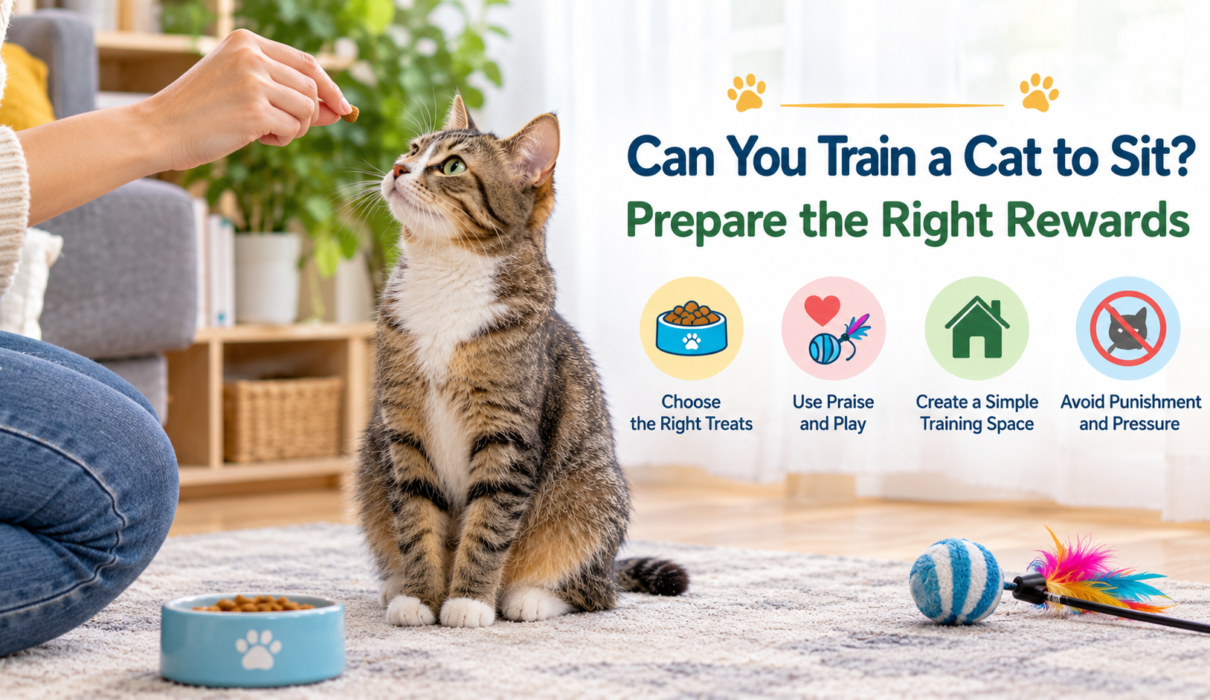
Can You Train a Cat to Sit? Prepare the Right Rewards
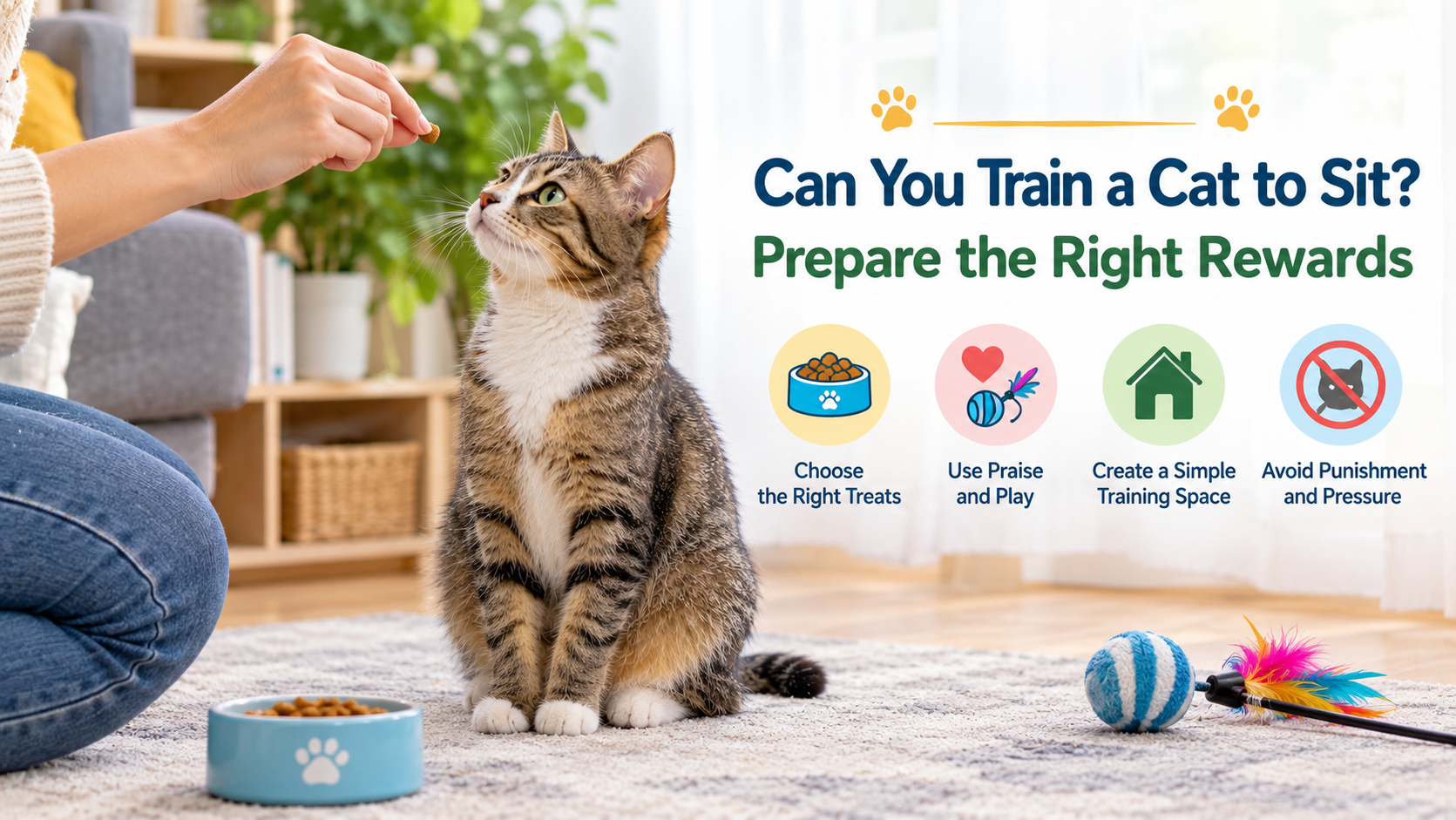
Yes, you can train many cats to sit using positive reinforcement. Kittens, young adult cats, and older cats can all learn, although their motivation, physical comfort, and learning speed may differ.
If you are wondering, can you train a cat to sit without making the process complicated, the answer is to begin with a simple reward system. Your cat needs to understand which behavior earns a positive outcome.
Select Treats Your Cat Enjoys
Small, appealing treats can make the learning process easier. Choose treats that are appropriate for your cat’s age and health, and offer only small portions or how to train a cat to sit.
You can use commercially prepared cat treats or tiny pieces of a suitable cat-safe food. Avoid ingredients that are toxic to cats, including onion, garlic, chocolate, and products containing xylitol.
If your cat has a medical condition or follows a special diet, ask your veterinarian which treats are suitable. Treats should complement a balanced diet rather than replace regular meals.
Keep rewards ready before starting. This allows you to deliver a treat immediately when your cat performs the desired behavior.
Use Praise and Play as Rewards
Food is not the only way to reward your cat. Some cats enjoy gentle praise, affection, or a short play session with a favorite toy.
Observe your pet’s reaction to different rewards. If your cat walks away when you try to pet it, do not use petting as a reward. Instead, choose something the cat actively enjoys.
The goal is to make the training experience positive. When your cat associates sitting with a pleasant outcome, it may become more willing to repeat the behavior or how to train a cat to sit.
Prepare a Simple Training Space
Choose a stable, nonslip surface where your cat can sit comfortably. A quiet room with limited distractions is usually a good starting point.
Bring a few treats, your chosen verbal command, and plenty of patience. Everyone in the household should use the same word and hand signal to avoid confusing the cat.
Do not begin by introducing several commands at once. Teaching one behavior at a time helps your cat understand exactly what earns a reward.
Avoid Punishment and Pressure
Never hit, frighten, or forcibly push your cat into a sitting position. These methods can create anxiety and make your pet less willing to approach you during future sessions or how to train a cat to sit.
If your cat does not respond, take a step back. Try using a more appealing reward, reducing distractions, or ending the session and practicing later.
Remember that successful training depends on cooperation. Your cat should always be able to move away if it feels uncomfortable.
How Do You Train a Cat to Sit? Follow These Simple Steps
Once you have selected your rewards and prepared a comfortable space, you can begin practicing. Understanding how do you train a cat to sit becomes much easier when you divide the process into small, manageable steps.
Step 1: Get Your Cat’s Attention
Sit or kneel near your cat without crowding it. Hold a small treat where your cat can see and smell it.
Wait for your cat to look toward you. You can say its name gently, but avoid shouting or repeatedly calling it if it is distracted.
When your cat pays attention, offer a little encouragement. The goal is to establish a calm interaction before introducing the sitting movement or how to train a cat to sit.
Step 2: Hold the Treat Near Your Cat’s Nose
Bring the treat close enough for your cat to smell it without allowing it to grab the treat immediately.
Keep your hand relaxed. If your cat becomes overly excited and starts pawing at your fingers, pause briefly and try again when it settles.
Make sure the treat is being used to guide the movement rather than as a distraction. Your cat should be able to follow it comfortably.
Step 3: Move the Treat Slowly Upward and Backward
Gradually move the treat upward and slightly backward over your cat’s head. Many cats naturally lower their hindquarters as they raise their head to follow the treat.
Move slowly enough for your cat to follow the motion. If you move the treat too far backward, your cat may turn around or walk away instead of sitting.
Do not pull the treat so high that your cat has to stretch uncomfortably. Adjust the movement according to your cat’s size and position or how to train a cat to sit.
Step 4: Wait for Your Cat to Sit
Watch your cat’s body rather than focusing only on the treat. When its hindquarters touch the floor and it settles into a sitting position, immediately mark the behavior with a consistent word such as “yes.”
Then provide the treat.
At first, your cat may sit only briefly. That is enough to begin learning. You do not need to demand a long, perfectly still position during the early sessions.
If your cat does not sit, reset and try again. Avoid repeatedly moving the treat or physically guiding your cat into position or how to train a cat to sit.
Step 5: Introduce the Verbal Command
Once your cat begins following the treat into a sitting position, introduce the word “sit.”
Say the command just before guiding your cat into position. When your cat sits, mark the behavior and give the reward.
Repeat the same sequence consistently. Over time, your cat may begin responding to the verbal cue rather than relying entirely on the treat movement.
Do not expect immediate results. Some cats understand quickly, while others need many short practice sessions before connecting the command with the action or how to train a cat to sit.
Step 6: Practice and Gradually Reduce the Lure
After your cat begins sitting reliably, start making the treat less visible during the hand movement. You can use the same hand signal without holding food in your fingers, then reward from your other hand.
Continue rewarding successful responses while gradually building consistency. Once your cat understands the command, you can sometimes use praise or play instead of food.
Avoid removing rewards too quickly. If your cat stops responding, return to an easier step and reward more frequently.
Common Training Problems and Solutions
Your cat keeps walking away: The session may be too long, the environment may be distracting, or your cat may not be interested in the reward. Try a quieter space and shorter sessions.
Your cat stands on its hind legs: The treat may be too high. Lower your hand and move it more gently backward.
Your cat grabs the treat: Hold the treat securely and reward only after the sitting movement. If necessary, use a treat that is easier to control or how to train a cat to sit.
Your cat sits but does not respond to the word: Continue pairing the verbal cue with the behavior. Avoid expecting the command to work before your cat has learned the association.
Your cat becomes frustrated: Stop, give your cat space, and try another time. Training should remain a positive activity.
Tricks to Train Your Cat: Six Simple Techniques Every Owner Should Know
There are several practical tricks to train your cat that can make learning to sit easier and more enjoyable. The first three techniques focus on guiding the behavior, introducing a clear command, and adding a hand signal.
Trick 1: Use a Treat to Guide Your Cat Into a Sitting Position
A food lure can help your cat discover the sitting movement naturally. Hold a small treat near its nose and move it slowly upward and slightly backward.
As your cat follows the treat, watch for the moment its hindquarters touch the floor. Mark the behavior and reward it immediately or how to train a cat to sit .
Repeat the exercise a few times, allowing your cat to move around naturally between attempts. If your cat becomes distracted or uninterested, take a break rather than continuing to offer treats.
The important point is timing. Reward the sitting behavior as soon as it happens so your cat can begin connecting the action with the positive result.
Once your cat understands the movement, gradually reduce the visible treat lure. This helps prevent your cat from learning to sit only when it sees food.
Trick 2: Introduce a Clear Verbal Command
Choose one short command, such as “sit,” and use it consistently. Avoid switching between different phrases during the same training session.
Say the word just before your cat performs the sitting movement. As soon as the cat sits, use your marker word and deliver the reward or Train Your Cat to Sit.
With repeated practice, your cat can begin associating the spoken command with the action. Be patient if your cat responds only when you also move your hand.
Do not repeat “sit” many times in a row. Say it once, give your cat a moment to respond, and then help with the hand signal if needed or how to train a cat to sit.
As your cat becomes more confident, gradually reduce the assistance. Reward correct responses so the command remains meaningful.
Trick 3: Add a Simple Hand Signal
Hand signals can make communication easier because cats can learn to associate visual cues with familiar behaviors.
Once your cat understands the basic sitting movement, choose a consistent gesture. For example, you might raise your open hand slightly while saying “sit.”
Use the same movement every time. Mark and reward the behavior when your cat responds correctly.
After several successful repetitions, try using the hand signal with less help from the treat lure. You can later practice the verbal command and hand signal separately to see whether your cat responds to each cue.
Keep your movements gentle and clear. Avoid sudden gestures that might startle your pet.
Hand signals are particularly useful when your surroundings are noisy or when you want to communicate without speaking loudly or Train Your Cat to Sit.
The most important principle is consistency. A simple gesture, a clear verbal command, and an immediate reward can help your cat understand what you are asking.
Tricks to Train Your Cat: Three More Simple Training Techniques
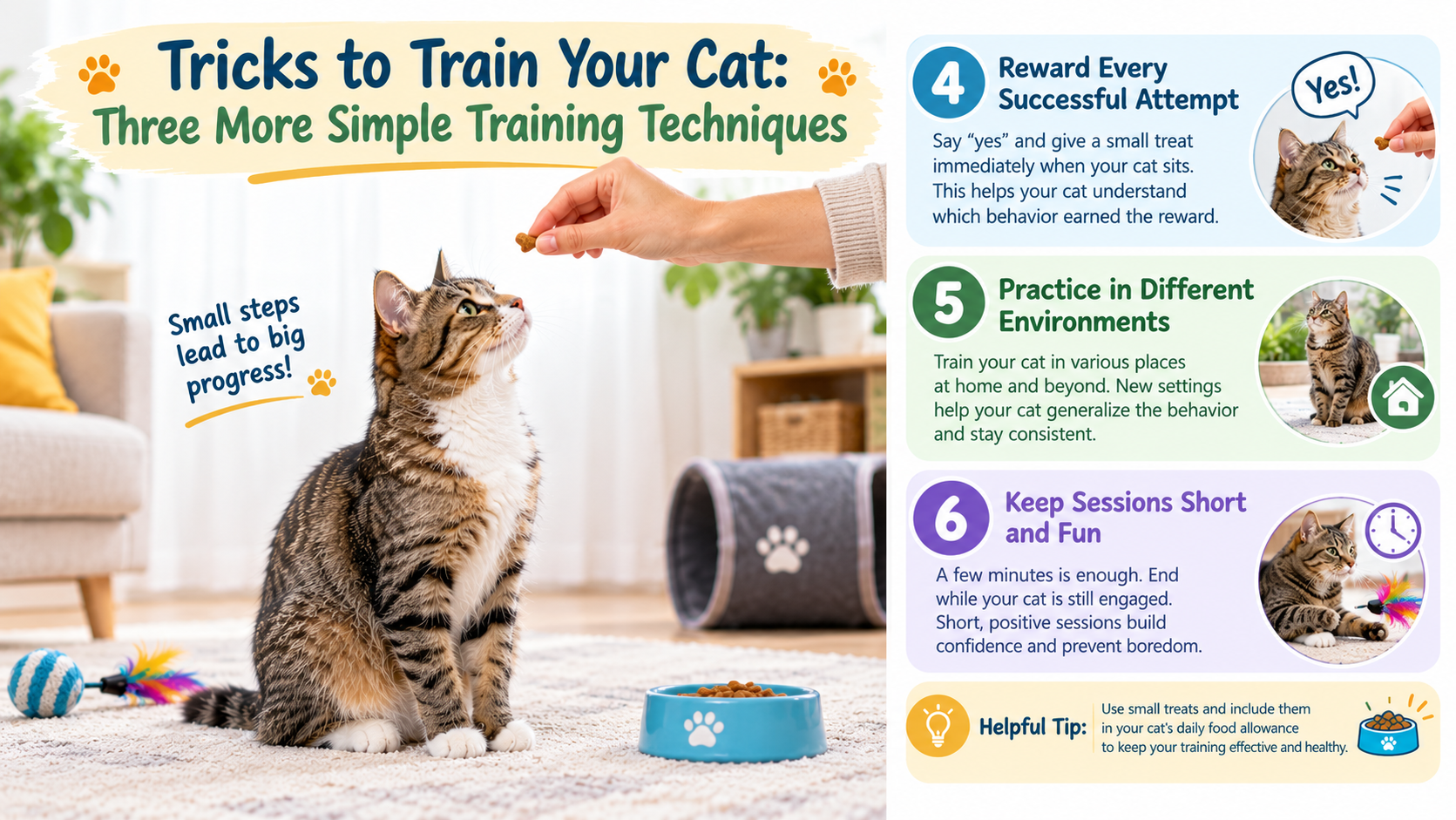
After your cat begins learning the sitting command, the next step is to make the behavior more consistent. The best tricks to train your cat involve rewarding successful attempts, practicing in different environments, and keeping training sessions short and enjoyable.
Remember that every cat learns at a different pace. Some cats may understand the command quickly, while others need more repetition. Patience and positive reinforcement will help your cat develop confidence.
Trick 4: Reward Every Successful Attempt
Rewarding the correct behavior is one of the most important parts of teaching your cat to sit. When your cat places its hindquarters on the floor after hearing the command or following your hand signal, immediately mark the behavior with a word such as “yes” and offer a small treat or Train Your Cat to Sit.
This helps your cat understand which action earned the reward.
During the early stages, reward each successful attempt so your cat can build a clear association between sitting and receiving something pleasant. Once the behavior becomes more reliable, you can gradually vary the rewards.
For example, you might reward some successful responses with treats and others with praise or a short play session. Continue offering occasional food rewards to maintain your cat’s motivation.
Avoid giving a treat when your cat performs an unrelated action, such as jumping up or walking away. Instead, wait for another opportunity to reward the desired sitting behavior.
Helpful tip: Keep treats small and include them in your cat’s daily food allowance. This helps prevent excessive calorie intake while maintaining an effective training routine.
Trick 5: Practice in Different Locations
Once your cat can sit in a quiet room, begin practicing in other familiar areas of your home. This helps your cat learn that the command applies in different situations, not just in one particular spot.
Start by practicing in a nearby room with few distractions. Use the same verbal command and hand signal, and reward successful responses or Train Your Cat to Sit.
As your cat becomes more comfortable, you can gradually introduce mild distractions, such as ordinary household sounds or another person sitting nearby.
Avoid moving directly into a busy environment. Too many distractions can make it difficult for your cat to focus, especially during the early stages of learning or how to train a cat to sit.
If your cat struggles to respond in a new location, return to a quieter space and practice again. You can then try the more challenging environment later.
Training in different locations also helps you understand your cat’s preferences. Some cats concentrate better on a familiar surface, while others respond well in several rooms.
The goal is not to make your cat obey in every situation immediately. Instead, build confidence gradually and keep each session positive.
Trick 6: Build Consistency With Short Daily Sessions
Short, regular practice sessions are usually more effective than one long session. Cats can lose interest when an activity becomes repetitive, so it is important to finish before your pet becomes frustrated.
Start with sessions lasting about two to five minutes. Depending on your cat’s interest, you may practice once or a few times throughout the day or Train Your Cat to Sit.
During each session, repeat the sitting exercise several times, allowing your cat to move naturally between attempts. Stop if your cat begins turning away, ignoring the treats, hiding, or showing other signs of discomfort.
Consistency also means using the same command and reward timing. If one person says “sit” while another uses a different word, your cat may take longer to understand the expected behavior.
Keep a simple record of your progress if helpful. Note whether your cat responds to the verbal command, follows a hand signal, or still needs a food lure.
Over time, these small improvements can help your cat develop a reliable response.
How to Train a Cat to Sit Without Treats
Food rewards are useful when teaching a new behavior, but some owners eventually want their cats to respond without seeing a treat first. Learning how to train a cat to sit without relying entirely on food involves gradually changing the reward system rather than removing rewards suddenly.
Start by Establishing the Sitting Command
Before reducing treats, make sure your cat understands what “sit” means. Your cat should be able to sit successfully with a verbal cue or hand signal in a quiet environment.
If your cat responds only when you hold a treat directly in front of its nose, continue practicing with the lure before moving to the next stage.
The goal is to teach the behavior first and then gradually reduce the visible food prompt.
Replace Some Treats With Other Rewards
Once your cat responds consistently, begin rewarding some successful attempts with praise, a favorite toy, or gentle affection if your cat enjoys it.
For example, you might offer a small treat after one successful sit and a brief play interaction after another.
Watch your cat’s reaction to each reward. A toy may be more motivating for an energetic cat, while another cat may prefer a food reward.
Do not assume that every cat enjoys being touched or picked up during training. Use rewards that your cat actively seeks out.
Fade the Treat Lure Gradually
One common training mistake is showing the treat before every command. Your cat may learn to follow the food rather than respond to the word “sit.”
To reduce this dependency, begin making the same hand gesture without holding a treat in that hand. When your cat sits, mark the behavior and retrieve a reward from your other hand.
As your cat improves, you can reward some responses with praise or play while continuing to provide occasional treats.
If performance becomes less reliable, make the exercise easier and reward more frequently again.
Keep Training Positive
Never withhold regular meals or punish your cat for failing to respond. Cats may ignore a command because they are distracted, tired, uncomfortable, or simply not interested at that moment.
If your cat walks away, allow it to take a break. You can try again later when it is alert and relaxed.
Successful training is based on cooperation. A cat that feels safe and enjoys the activity is more likely to participate willingly or Train Your Cat to Sit.
Cat Training Buttons: Can They Help Teach Your Cat to Sit?
Cat training buttons are devices that play recorded words or sounds when pressed. Some owners use them to explore communication with their cats, while others incorporate them into reward-based activities.
Although cat training buttons can be an interesting addition to your cat’s routine, they are not necessary for teaching a basic sitting command.
What Are Cat Training Buttons?
These buttons usually allow owners to record a word, such as “food,” “play,” or “outside.” When a cat presses the button, the recording plays.
Some cats learn to press buttons through repeated demonstrations and rewards. However, pressing a button does not automatically mean the cat understands human language in the same way a person does.
A cat may learn that pressing a particular button predicts a specific event or reward. This association can still make button activities engaging and useful for enrichment.
Can Buttons Help Teach Your Cat to Sit?
You can introduce a button as an additional cue during training, but a verbal command and hand signal are generally simpler starting points or Train Your Cat to Sit.
For example, you might record the word “sit” on a button and play it immediately before giving your usual verbal cue. Then guide your cat into the sitting position and reward the behavior.
However, this does not guarantee that your cat will learn to press the button to request sitting or understand the word independently.
Keep the process simple. Teach the sitting behavior first, and introduce the button only if your cat seems comfortable with the device or how to train a cat to sit.
How to Introduce Cat Training Buttons
Follow these steps to introduce buttons safely:
- Choose a quiet location: Place the button on a stable surface where your cat can investigate it comfortably.
- Introduce the sound: Press the button yourself and allow your cat to hear the recording without forcing it to approach.
- Connect the cue with an activity: If you are using a “sit” recording, play it before your normal sitting exercise.
- Reward the desired behavior: Mark and reward your cat when it sits.
- Practice gradually: Keep sessions short and stop if the sound appears to frighten or irritate your cat.
Never force your cat to press a button or repeatedly play a sound if your pet seems uncomfortable.
Limitations of Cat Training Buttons
Buttons can provide mental stimulation, but they are not a shortcut to reliable training. Some cats may ignore them, while others may enjoy pressing them without making a clear connection to the intended activity.
Buttons also require patience and consistent use. If your goal is simply to teach your cat to sit, a clear command, a hand signal, and positive reinforcement may be all you need.
Choose training methods according to your cat’s personality rather than purchasing equipment unnecessarily.
Common Mistakes to Avoid When Teaching Your Cat to Sit
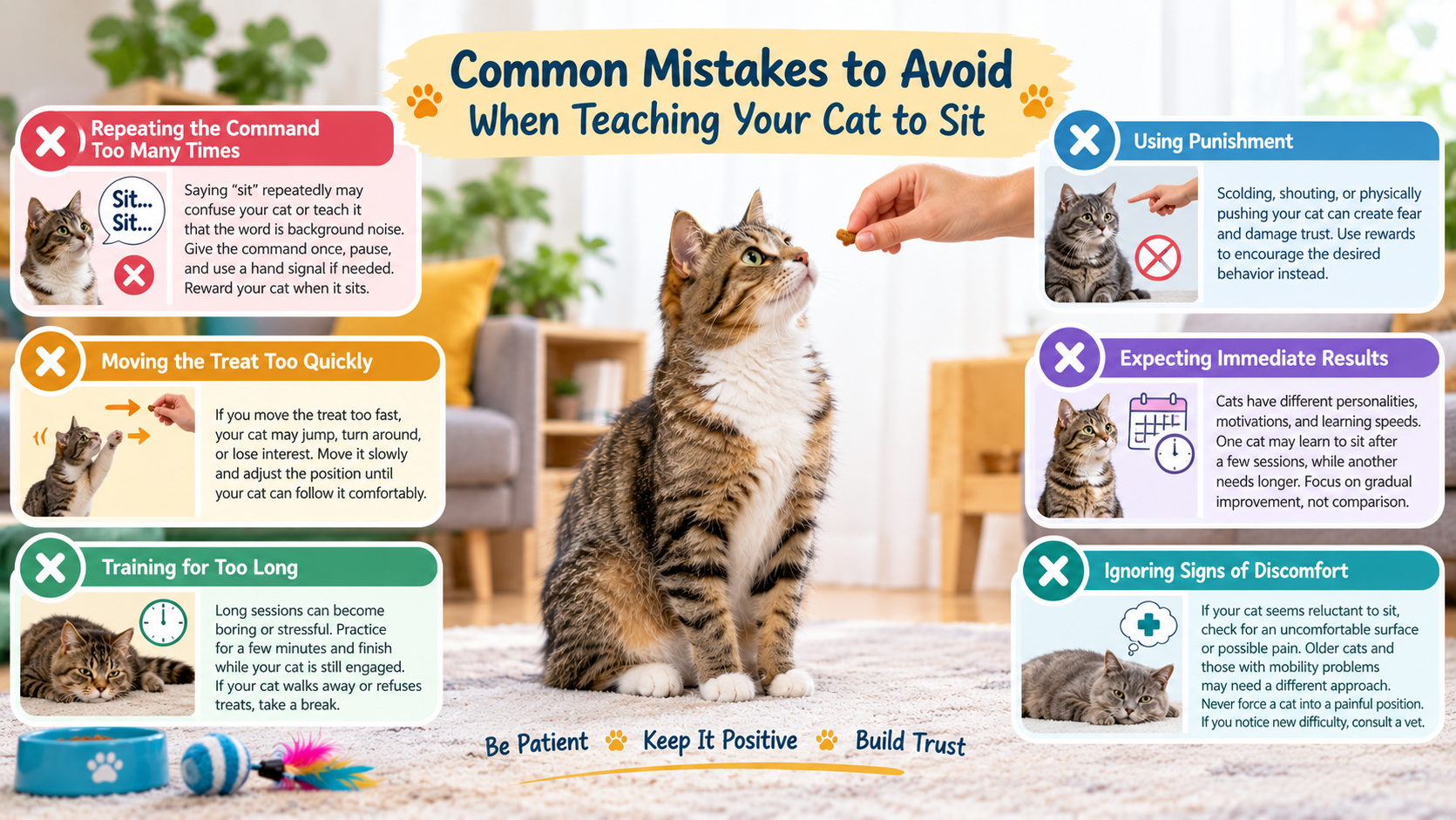
Even with a good training plan, certain mistakes can slow your progress. Understanding them can help you make training easier and more enjoyable.
Repeating the Command Too Many Times
Saying “sit” repeatedly may confuse your cat or teach it that the word is background noise.
Instead, give the command once, pause briefly, and use a familiar hand signal if necessary. Reward your cat when it performs the desired behavior or Train Your Cat to Sit.
Moving the Treat Too Quickly
If you move the treat too fast, your cat may jump, turn around, or lose interest. Move it slowly and adjust the position until your cat can follow it comfortably.
Training for Too Long
Long sessions can become boring or stressful. Practice for a few minutes and finish while your cat is still engaged.
If your cat starts walking away or refusing treats, take a break rather than insisting on another attempt.
Using Punishment
Scolding, shouting, or physically pushing your cat into position can create fear and damage trust. Use rewards to encourage the desired behavior instead.
Expecting Immediate Results
Cats have different personalities, motivations, and learning speeds. One cat may learn to sit after a few sessions, while another needs longer.
Focus on gradual improvement rather than comparing your cat with other pets.
Ignoring Signs of Discomfort
If your cat seems reluctant to sit, consider whether the surface is uncomfortable or whether movement may be painful. Older cats and cats with mobility problems may need a different approach.
Never force a cat into a position that appears painful. If you notice new difficulty sitting, stiffness, or other concerning changes, consult a veterinarian.
How Long Does It Take to Teach a Cat to Sit?
There is no fixed timeline for teaching this command. Some cats may begin understanding the sitting movement within a few short sessions, while others may need days or weeks of consistent practice.
Several factors influence how quickly your cat learns.
Age and Personality
Kittens can be curious and playful, but their attention may shift quickly. Adult cats can also learn new behaviors, particularly when the reward is appealing and the training environment is comfortable.
A cautious cat may need more time to feel safe, while a highly food-motivated cat may engage more readily or Train Your Cat to Sit.
Previous Training Experience
Cats that already respond to their names or understand simple reward-based exercises may adjust more quickly to a new command.
However, a cat with no previous training can still learn to sit. Begin with the basic movement and introduce the verbal cue once your cat starts succeeding.
Consistency and Reward Timing
Regular, short sessions help your cat recognize patterns. Immediate rewards make it easier to connect the sitting action with the positive outcome or how to train a cat to sit.
If training is inconsistent, your cat may take longer to understand what is expected.
Signs Your Cat Is Making Progress
Look for small improvements, such as following the treat more smoothly, sitting more often, or responding to a hand signal with less assistance.
Eventually, your cat may sit when you give the verbal command without needing to see food first.
If your cat struggles, return to a simpler step instead of repeating a difficult exercise. Adjusting the training plan can make learning easier.
Frequently Asked Questions About How to Train a Cat to Sit
Can You Train a Cat to Sit Like a Dog?
Yes, many cats can learn a sitting command, although they may respond differently from dogs. Cats often benefit from short sessions, motivating rewards, and opportunities to stop when they lose interest.
The most effective approach is to work with your cat’s natural behavior rather than expecting it to learn exactly like another animal or how to train a cat to sit.
How Do You Train a Cat to Sit Without Using Treats?
Start by teaching the sitting behavior with an effective reward. Once your cat understands the command, gradually replace some food rewards with praise, play, or another activity your cat enjoys.
Do not remove treats entirely before your cat understands the behavior. Occasional food rewards can also help maintain motivation or Train Your Cat to Sit.
What Is the Best Age to Teach a Cat to Sit?
There is no single best age. Kittens can begin learning simple behaviors when they are comfortable and able to focus, while adult and senior cats can also learn at an appropriate pace.
Adjust the training session to your cat’s energy, mobility, and health.
How Many Minutes a Day Should You Train Your Cat?
Begin with sessions of approximately two to five minutes. You can practice more than once daily if your cat remains interested.
Short sessions are generally preferable to long, repetitive exercises. Stop if your cat becomes distracted, frustrated, or uncomfortable.
Do Cat Training Buttons Help With Basic Commands?
Cat training buttons can provide enrichment and introduce recorded cues, but they are not essential for basic obedience exercises.
A consistent verbal command, a simple hand signal, and immediate positive reinforcement are usually sufficient for teaching a cat to sit.
Conclusion: How to Train a Cat to Sit With Patience and Positive Reinforcement
Learning how to train a cat to sit can be a rewarding way to build communication and strengthen your relationship with your pet. With a few simple techniques, you can encourage your cat to understand a verbal command, follow a hand signal, and respond more consistently or how to train a cat to sit.
Remember the six essential tricks: guide your cat with a treat, introduce a clear verbal command, add a hand signal, reward successful attempts, practice in different locations, and keep sessions short.
You can gradually reduce visible food lures as your cat learns, while continuing to use rewards that maintain motivation. Cat training buttons may offer extra enrichment, but they are optional rather than necessary or Train Your Cat to Sit.
Most importantly, remain patient and avoid punishment. Every cat learns at its own pace, and small improvements are worth celebrating. Make training a positive experience, respect your cat’s comfort, and enjoy the progress you make together.