

 By
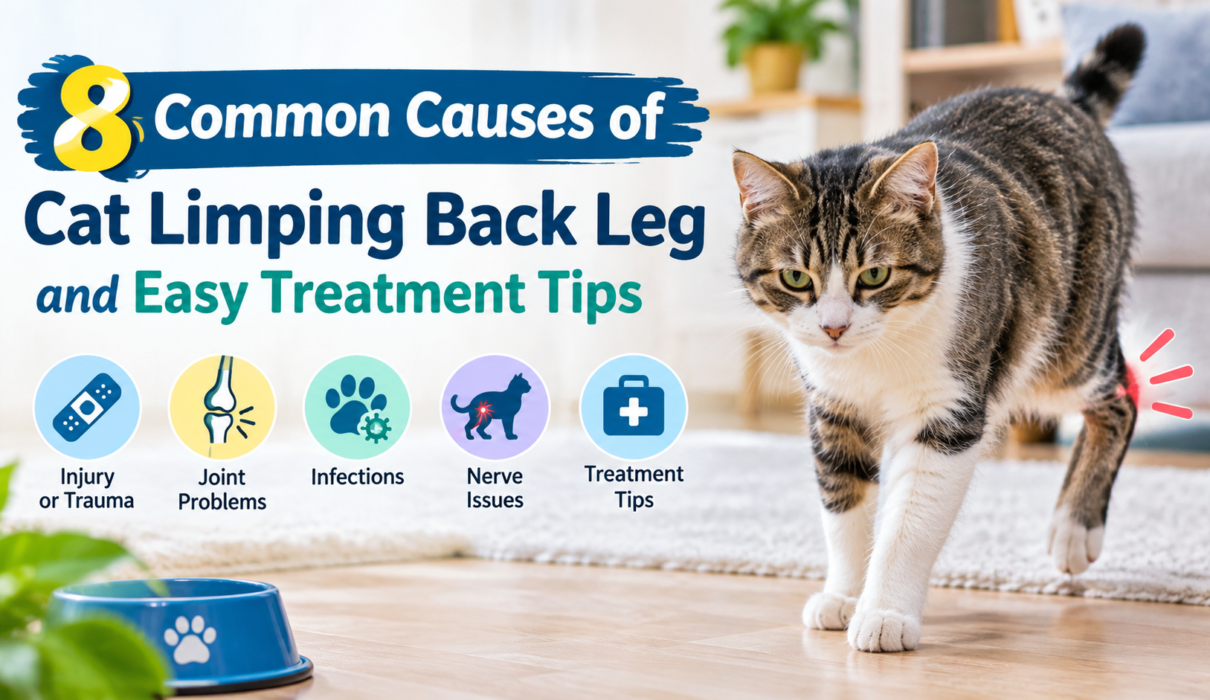
8 Common Causes of Cat Limping Back Leg and Easy Treatment Tips
Cats are naturally active animals that love jumping, running, climbing, and exploring. Because of this active lifestyle, it is not unusual for a cat to develop a sore paw or leg after an accident or sudden movement. However, cat limping should not always be ignored because it can sometimes indicate an injury, infection, joint problem, or another underlying condition.
If you notice that your cat is limping, pay attention to when the problem started and whether your cat is still putting weight on the affected leg. A cat that suddenly refuses to use a leg may need prompt veterinary attention.
If you are wondering, why is my cat limping, the answer can range from a small paw injury to a more serious orthopedic problem. In this first part, we will discuss five common causes of cat limping and the signs you should watch for.
What Is Cat Limping?
Cat limping occurs when a cat changes the way it walks because of pain, weakness, injury, or discomfort in a leg or paw. Your cat may walk with a noticeable limp, avoid putting weight on one leg, or keep the affected leg lifted.
Sometimes the cause is easy to see, such as a cut on the paw. Other times, there may be no obvious external injury.
Watch for other changes, including:
- Walking more slowly than usual
- Avoiding stairs or jumping
- Hiding more than normal
- Licking or chewing one leg
- Swelling around a joint or paw
- Difficulty getting up
- Reduced activity
- Crying or reacting when touched
- Refusing to put weight on a leg
Never force a painful cat to walk or manipulate an injured leg. If your cat appears to be in severe pain, keep movement to a minimum and contact a veterinarian.
Cat Limping From a Minor Injury
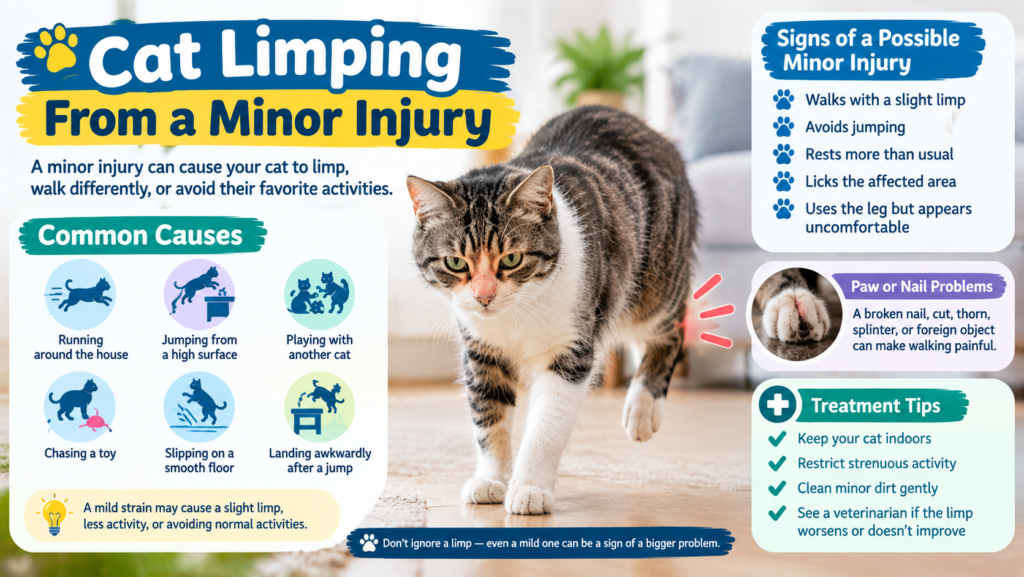
One of the common reasons for cat limping is a minor injury. Cats can strain a muscle, twist a joint, bruise a paw, or land awkwardly after jumping from furniture.
A minor injury may happen during:
- Running around the house
- Jumping from a high surface
- Playing with another cat
- Chasing a toy
- Slipping on a smooth floor
- Landing awkwardly after a jump
A mild strain may cause your cat to walk differently while still using the affected leg. Some cats may become less active and avoid activities they normally enjoy.
Signs of a Possible Minor Injury
You may notice that your cat:
- Walks with a slight limp
- Avoids jumping
- Rests more than usual
- Licks the affected area
- Uses the leg but appears uncomfortable
If your cat has only a mild limp and otherwise seems comfortable, you can keep it indoors and restrict strenuous activity while monitoring the situation. However, if the limp becomes worse, does not improve, or your cat stops using the leg, a veterinary examination is appropriate.
Do not assume that a mild-looking limp is harmless if it continues.
Cat Limping Back Leg Due to Paw or Nail Problems
If you notice cat limping back leg, the problem may actually be in the paw or claws rather than the leg itself.
Cats can injure their paws in several ways. A broken nail, small cut, thorn, splinter, or other foreign object can make walking painful.
Common Paw Problems That Can Cause Cat Limping
Some possibilities include:
- Torn or broken nails
- Cuts on the paw pad
- Puncture wounds
- Something stuck between the toes
- Irritated paw pads
- Swelling around the toes
- A damaged claw
Carefully look at the affected paw if your cat is calm and allows you to do so. Compare it with the other paw and look for obvious differences such as swelling, bleeding, a damaged nail, or something stuck between the toes.
Do not force the paw open if your cat is frightened or painful. Cats may scratch or bite when they are hurting.
What Can You Do for a Paw Problem?
If there is a small amount of dirt on the paw, gently cleaning the area may help. Keep the cat indoors and prevent excessive running or jumping.
However, a deep wound, significant bleeding, severe swelling, a badly damaged nail, or a foreign object embedded in the paw should be evaluated by a veterinarian.
Avoid cutting, pulling, or digging into a painful area yourself because this can make an injury worse.
Cat Limping Caused by Arthritis and Joint Problems
Another possible cause of cat limping is arthritis or another joint problem. Arthritis is particularly common in older cats, although joint problems can occur for other reasons as well.
Unlike an acute injury, arthritis may develop gradually. You might not notice an obvious accident.
Signs of Joint Problems in Cats
A cat with joint discomfort may:
- Move more slowly
- Stop jumping onto favorite furniture
- Have difficulty climbing stairs
- Sleep more
- Appear stiff after resting
- Avoid playing
- Have difficulty getting into or out of the litter box
- Groom certain areas less often
Some cats do not show obvious signs of pain. Instead, their behavior slowly changes.
If your older cat suddenly becomes less active or begins having difficulty jumping, do not automatically assume that the behavior is simply due to age. A veterinarian can evaluate your cat and determine whether arthritis or another condition could be contributing to the problem.
Helping a Cat With Possible Joint Problems
A veterinarian may recommend treatment based on the cause and severity of the joint problem. Keeping your cat at a healthy body weight can also be important for reducing unnecessary stress on the joints.
Make daily activities easier by providing comfortable resting areas and making food, water, and litter facilities easy to access.
Never give your cat human arthritis or pain medication unless specifically instructed by a veterinarian. Some human medicines can be dangerous or even fatal to cats.
Cat Limping From a Broken Bone or Serious Injury
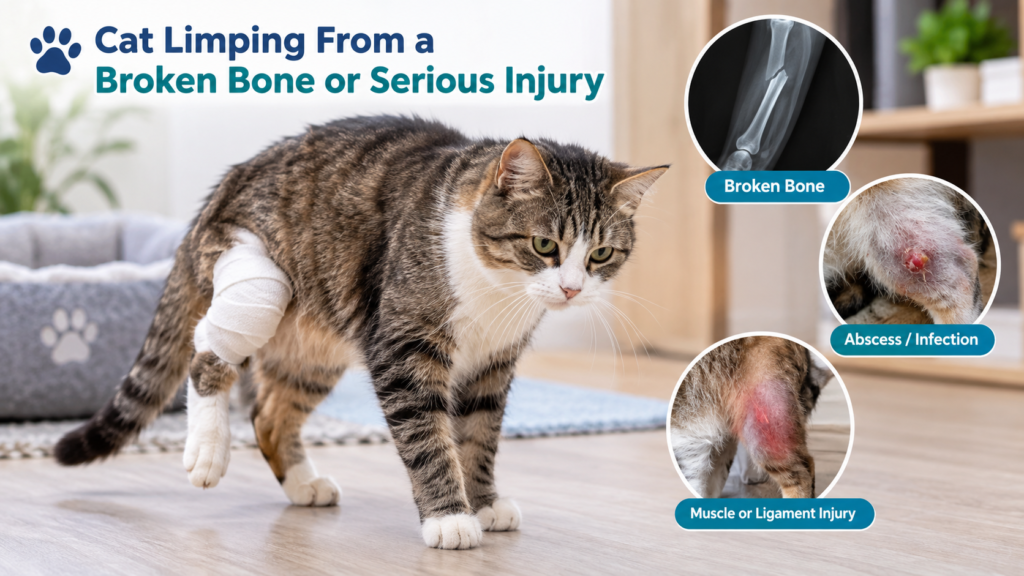
A fracture or other serious injury can cause sudden and noticeable cat limping. This can happen after a fall, road accident, fight, or other trauma.
A cat with a serious injury may completely refuse to put weight on the affected leg.
Possible Signs of a Fracture or Serious Injury
Watch for:
- Sudden severe limping
- Refusal to use a leg
- Significant swelling
- Severe pain
- An unusual position of the leg
- Visible deformity
- Crying or reacting strongly to movement
- Difficulty standing or walking
If you suspect that your cat has a broken bone, do not attempt to straighten the leg or make a homemade splint. Unnecessary handling can increase pain and potentially worsen the injury.
Keep your cat as still and calm as possible and contact a veterinarian promptly.
If the injury occurred after major trauma, such as being hit by a vehicle or falling from a significant height, your cat may have internal injuries even if the leg does not look severely damaged. Such trauma requires urgent veterinary assessment.
Cat Limping From an Abscess or Infection
If your cat is limping and you notice swelling, warmth, redness, or a painful lump, an abscess or infection could be responsible.
Abscesses can develop when bacteria enter a wound. Bite wounds from fights with other cats are a common way for bacteria to get under the skin.
Small puncture wounds can sometimes be difficult to notice because they may close over quickly while an infection develops underneath.
Signs of an Abscess
Possible signs include:
- A painful lump
- Swelling
- Warmth around the affected area
- Redness
- Pus or drainage
- Bad odor from a wound
- Excessive licking
- Reduced appetite
- Low energy
- Fever
A cat with an abscess may limp if the infection is located near a leg or joint.
Cat Limping Back Leg From Muscle or Ligament Problems
A cat may develop cat limping back leg because of a muscle strain, ligament injury, or another soft-tissue problem. These injuries can happen after running, jumping, playing, or making a sudden movement.
Unlike a broken bone, a muscle or ligament injury may not cause an obvious deformity. Your cat may still be able to walk but may move more carefully.
Signs of a Muscle or Ligament Injury
Your cat may:
- Limp after physical activity
- Avoid jumping
- Walk more slowly
- Rest more than usual
- Lick the affected area
- Have difficulty climbing
- Put less weight on one leg
Sometimes the limp may appear mild at first and become more noticeable after activity.
What Can You Do?
The safest initial approach is to reduce your cat’s activity. Keep your cat indoors and prevent running, jumping, and rough play.
Provide a comfortable resting area where food, water, and the litter box are easy to reach.
Do not massage or stretch the affected leg unless a veterinarian has specifically recommended it. Manipulating an injured joint or muscle could make the problem worse.
If the limp does not improve, becomes more severe, or your cat stops using the leg, arrange a veterinary examination.
Cat Is Limping Because of Bone, Joint, or Other Health Conditions
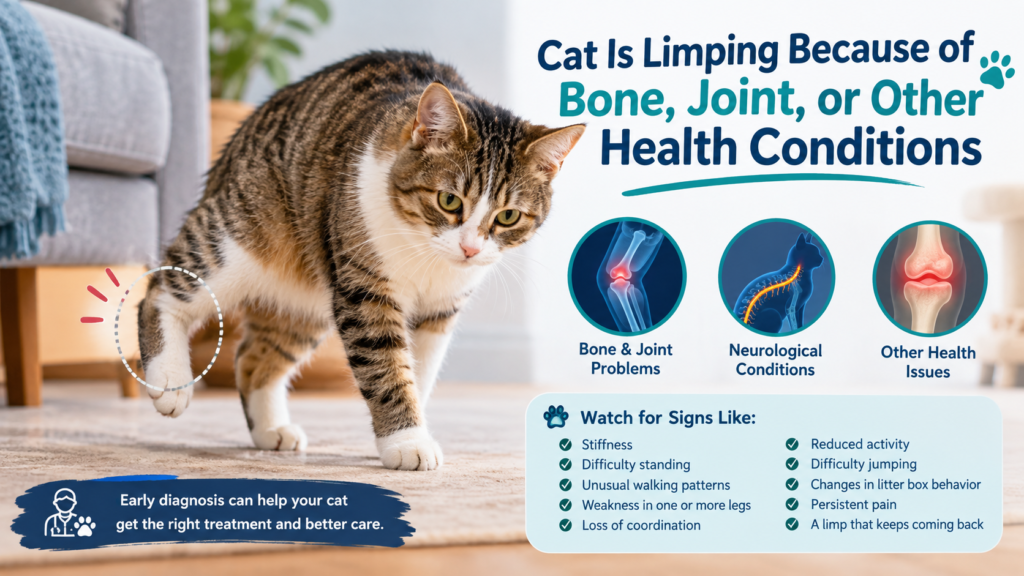
Sometimes cat limping is connected to an underlying bone, joint, or neurological problem. These conditions may be more difficult to identify at home because there may be no visible wound.
Some cats develop chronic joint problems, while others may have conditions affecting the bones or nerves that control movement.
Possible Signs of an Underlying Problem
Pay attention if your cat is limping along with:
- Ongoing stiffness
- Difficulty standing
- Unusual walking patterns
- Weakness in one or more legs
- Loss of coordination
- Reduced activity
- Difficulty jumping
- Changes in litter box behavior
- Persistent pain
A limp that repeatedly comes back should not simply be ignored.
A veterinarian may perform a physical examination and, depending on the symptoms, recommend diagnostic tests such as X-rays or other investigations.
Why Diagnosis Matters
Different causes of limping can look similar. For example, a cat with a joint problem may limp in a way that looks similar to a cat with a soft-tissue injury.
Finding the underlying cause allows the veterinarian to recommend appropriate treatment instead of treating only the visible symptom.
My Cat Is Limping Suddenly: What Should I Do?
If you suddenly notice, my cat is limping, stay calm and observe your cat carefully.
First, prevent your cat from running, jumping, or climbing. A painful cat may make the injury worse by continuing normal activities.
Step 1: Keep Your Cat Calm
Move your cat to a quiet and comfortable area. If possible, keep the cat in a small safe room where jumping and climbing are limited.
Step 2: Look at the Paw
If your cat is calm and allows you to do so, gently look at the affected paw.
Check for:
- Cuts
- Swelling
- Broken nails
- Bleeding
- Foreign objects
- Obvious irritation
Do not force your cat to allow an examination.
Step 3: Observe Weight-Bearing
Notice whether your cat is using the leg.
A cat that can walk but has a mild limp may have a less severe problem, although only a veterinarian can determine the actual cause.
A cat that completely refuses to put weight on the leg may have a more serious injury and should be evaluated promptly.
Step 4: Monitor Other Symptoms
Watch for changes such as:
- Loss of appetite
- Hiding
- Weakness
- Excessive licking
- Swelling
- Vocalization
- Difficulty standing
- Breathing problems
Multiple symptoms together can indicate that the problem requires prompt veterinary attention.
What Should You Do About a Possible Infection?
Do not squeeze or attempt to drain an abscess yourself. An infected wound may need professional treatment, and the veterinarian can determine whether drainage, medication, wound care, or other treatment is necessary.
If your cat has a swollen or painful area, particularly after being outside or involved in a fight, arrange a veterinary examination.
When Cat Limping Needs Veterinary Attention
Not every mild limp is an emergency, but some signs require prompt professional attention.
Contact a veterinarian if your cat:
- Cannot put weight on a leg
- Has severe or obvious pain
- Has significant swelling
- Has a visible deformity
- Has a deep or bleeding wound
- Has been involved in major trauma
- Has a painful swollen lump
- Seems weak or unusually quiet
- Stops eating or drinking
- Has a limp that persists or gets worse
If you are unsure why is my cat limping, it is safer to have persistent or severe symptoms assessed rather than trying to diagnose the problem at home.
Final Thoughts on Cat Limping
There are many possible causes of cat limping, and the location of the problem is not always obvious. A limp may come from a paw or nail injury, minor strain, arthritis, fracture, infection, or another condition.
If you notice cat limping back leg, carefully observe your cat without forcing movement. Look for visible injuries only if your cat allows a safe examination, and avoid giving human medications.
In Part 2, we will cover additional causes of cat limping, practical treatment and care tips, what to do when my cat is limping suddenly, and important warning signs that mean your cat should be seen by a veterinarian.
Easy Treatment Tips for Cat Limping
Treatment for cat limping depends on the underlying cause. There is no single treatment that works for every type of limp.
However, several safe supportive measures can help while you arrange appropriate care.
Give Your Cat Rest
Limit running, jumping, and rough play. If your cat normally spends time outdoors, keeping it indoors can make it easier to control activity and monitor symptoms.
Make the Home Safer
Temporarily block access to high furniture, stairs, or other areas where your cat may jump.
Place food and water somewhere easily accessible so your cat does not have to climb or travel far.
Provide a Comfortable Resting Area
Give your cat a quiet, comfortable place to sleep. A soft bed in an easily accessible location can help an uncomfortable cat rest.
Monitor the Affected Leg
Keep track of whether the limp is improving, staying the same, or becoming worse.
You can also note:
- When the limp started
- Which leg is affected
- Whether your cat can bear weight
- Any swelling or wounds
- Changes in appetite or behavior
This information can be useful when speaking with your veterinarian.
Follow Veterinary Instructions
If your veterinarian diagnoses the cause of the limp, follow the recommended treatment and activity restrictions carefully.
Even if your cat appears better, avoid returning immediately to intense exercise unless your veterinarian says it is safe.
What Not to Do When Your Cat Is Limping
When my cat is limping, it can be tempting to try home remedies. Some actions, however, can be dangerous.
Do Not Give Human Pain Medication
Never give your cat human painkillers unless a veterinarian specifically tells you to use a particular medication and dose.
Some medications that are commonly used by people can be toxic to cats.
Do Not Force the Leg to Move
Avoid bending, stretching, or twisting the affected leg to determine where the pain is coming from.
Do Not Attempt to Set a Broken Bone
If you suspect a fracture, do not try to straighten the leg or create your own splint. Keep your cat as still as possible and seek veterinary care.
Do Not Ignore Persistent Limping
A mild limp that continues or repeatedly returns deserves attention. Cats can hide pain, so a cat that is still eating and behaving relatively normally may still have a medical problem.
When Should You Worry About Cat Limping?
Some cases of cat limping require more urgent attention than others.
Seek prompt veterinary care if your cat:
- Suddenly stops using a leg
- Has severe pain
- Cannot stand or walk normally
- Has significant swelling
- Has a visible deformity
- Has heavy bleeding
- Has a deep wound
- Was hit by a vehicle
- Fell from a significant height
- Was involved in major trauma
- Has a painful swollen lump
- Becomes extremely weak
- Stops eating
- Has difficulty breathing
A serious injury may involve more than the leg, particularly after major trauma.
Why Is My Cat Limping? Quick Checklist
If you are wondering why is my cat limping, consider these common possibilities:
Paw or Nail Problem
A damaged nail, cut, puncture, or foreign object can make walking painful.
Minor Injury
A strain, sprain, or bruise can cause temporary limping.
Arthritis
Joint inflammation and degeneration can cause stiffness and difficulty moving.
Fracture
A broken bone can cause sudden and severe limping, often with an inability to bear weight.
Abscess
An infected bite or wound can cause swelling, pain, and limping.
Muscle or Ligament Injury
Soft-tissue injuries can occur after running, jumping, or sudden movements.
Joint or Bone Condition
Persistent or recurring limping can sometimes be related to an underlying orthopedic condition.
Other Health Problems
Neurological or other medical conditions can occasionally affect how a cat walks.
Frequently Asked Questions About Cat Limping
Why is my cat limping but not crying?
Cats do not always vocalize when they are in pain. Some cats may continue eating and behaving normally while quietly avoiding weight on an injured leg. A lack of crying does not necessarily mean there is no pain.
What should I do if my cat is limping on its back leg?
Keep your cat calm and restrict jumping and running. If your cat allows it, gently look at the paw for an obvious problem. If the limp is severe, persistent, or accompanied by swelling or other symptoms, contact a veterinarian.
Can a cat limping back leg heal on its own?
Some minor strains or superficial injuries may improve with rest, but it is not possible to know the cause of a limp simply by looking at it. Persistent or worsening cat limping back leg should be evaluated by a veterinarian.
How long should I wait if my cat is limping?
The appropriate amount of observation depends on the severity and other symptoms. A cat with severe pain, a visible injury, or an inability to use the leg should not be left waiting. For a mild limp, monitor closely and seek veterinary advice if it does not improve or becomes worse.
Should I take my cat to the vet if it is limping?
A veterinary examination is particularly important when the limp is sudden and severe, your cat cannot bear weight, there is swelling or deformity, or the problem persists.
Can I give my cat pain medicine for limping?
Do not give human pain medication unless your veterinarian specifically directs you to do so. Cats can react very differently to medications, and some human medicines can be dangerous for them.
Why is my cat limping suddenly?
Sudden cat limping can result from an injury, paw problem, broken nail, fracture, abscess, muscle injury, or another condition. The severity of the limp and other symptoms can help determine how urgently your cat needs veterinary care.
Conclusion
Cat limping can have many causes, ranging from minor paw problems and muscle strains to fractures, infections, arthritis, and other medical conditions.
If your cat is limping, start by keeping it calm and restricting physical activity. Avoid forcing the leg to move and never give human pain medication without veterinary guidance.
If you are asking, why is my cat limping, remember that the exact cause cannot always be determined at home. Severe, sudden, persistent, or worsening limping should be assessed by a veterinarian.
For cat limping back leg, paying attention to changes in walking, weight-bearing, swelling, appetite, and behavior can help you recognize when professional care is needed.
1 Comment