

 By
By How to adopt a dog in USA?
Adopting a dog is one of the most fulfilling choices you can make, but it is also a serious responsibility. Each year, millions of dogs find themselves in shelters throughout the United States waiting to go to a loving home. Adoption is a better choice than destroying animals, as it gives a dog a second chance at life and helps to reduce the overpopulation of animals, as well as unethical breeding practices.
If you’re wondering how to adopt a dog in the USA, you’re not alone. Numerous first-time adopters are intimidated by the process, requirements, and decisions that are involved. The good news? dog adoption process can be much easier when broken down into a set of easy-to-follow steps.
This novice guide will take you through all you need to know- whether you are ready or not and how to bring your new dog home. The initial three fundamental actions will be the focus of this Part:
If you’re wondering how to adopt a dog in the USA, you’re not alone. Numerous first-time adopters are intimidated by the process, requirements, and decisions that are involved. The good news? dog adoption process can be much easier when broken down into a set of easy-to-follow steps.
This novice guide will take you through all you need to know- whether you are ready or not and how to bring your new dog home. The initial three fundamental actions will be the focus of this Part:
- Choosing whether or not you are ready to get a dog.
- The selection of the appropriate breed of dog.
- Studying the possibilities of adoption in the USA.
At the conclusion of this section, you will have a good foundation and confidence to proceed.
Some Simple dog adoption process
Step 1: Determine whether you are prepared to have a dog.
It is critical to take a pause and consider your preparedness before rushing into adoption listings or visiting shelters. Underestimating the commitment it entails is one of the most common errors that new owners make.
Evaluate Your Lifestyle
Dogs need time, attention, and consistency. Ask yourself:
• Do you have long working hours or travel a lot?
• Are you able to find time every day to walk, feed, and play?
• Are you active or are you inclined to a more relaxed schedule?
For example, high-energy breeds such as Border Collies and Huskies require exercise and mental stimulation. Conversely, breeds such as Bulldogs or geriatric dogs tend to be more easygoing.
One of the best tips for adopting a dog is to choose one that suits your current lifestyle, not the one you would have preferred to live with.
• Do you have long working hours or travel a lot?
• Are you able to find time every day to walk, feed, and play?
• Are you active or are you inclined to a more relaxed schedule?
For example, high-energy breeds such as Border Collies and Huskies require exercise and mental stimulation. Conversely, breeds such as Bulldogs or geriatric dogs tend to be more easygoing.
One of the best tips for adopting a dog is to choose one that suits your current lifestyle, not the one you would have preferred to live with.
Know and comprehend the Financial Responsibility.
Having a dog is not just about paying the adoption fee. You will have to budget on:
• Food and treats
• Routine vet visits
• Vaccinations and medications
• Grooming
• Pet insurance (not obligatory, yet a good idea)
The average cost of owning a dog in the USA can range between 1,000 and 3,000 per year, depending on the size and needs of a particular dog.
Surprising costs, such as emergency vet visits, may also occur. Financial preparedness will help you provide proper care without stress.
• Food and treats
• Routine vet visits
• Vaccinations and medications
• Grooming
• Pet insurance (not obligatory, yet a good idea)
The average cost of owning a dog in the USA can range between 1,000 and 3,000 per year, depending on the size and needs of a particular dog.
Surprising costs, such as emergency vet visits, may also occur. Financial preparedness will help you provide proper care without stress.
Think About Your Household Situation.
The place that you live in contributes a lot to whether or not you are ready to have a dog.
• Do you have kids? Some dogs are more family-oriented.
• Do you have pets already? Compatibility is crucial.
• Do you rent or own your home? Numerous rentals have dog policies.
Allergies and noise tolerance should be considered, particularly when you live in an apartment or near others.
• Do you have kids? Some dogs are more family-oriented.
• Do you have pets already? Compatibility is crucial.
• Do you rent or own your home? Numerous rentals have dog policies.
Allergies and noise tolerance should be considered, particularly when you live in an apartment or near others.
Think Long-Term Commitment
Dogs cannot be short-lived companions. The majority are between 10 and 15 years old, and some are even older. That means:
• Daily care for years
• Emotional attachment and care.
• Replacing your life plans with your pet.
Many dogs end up back in shelters because owners are not fully prepared. Even now, by taking the time to think, you can prevent heartbreak in the future.
• Daily care for years
• Emotional attachment and care.
• Replacing your life plans with your pet.
Many dogs end up back in shelters because owners are not fully prepared. Even now, by taking the time to think, you can prevent heartbreak in the future.
Step 2: Select an appropriate form of Dog.
After you have made sure that you are ready, the next thing that you need to learn about how to adopt a dog in USA is to identify the right dog to adopt to fit your situation.
This is an important step because not all dogs are the same, and a mismatch can lead to frustration for both you and the dog.
This is an important step because not all dogs are the same, and a mismatch can lead to frustration for both you and the dog.
Breed vs. Mixed Breed.
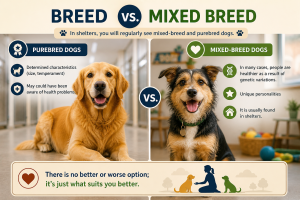
In shelters, you will regularly see mixed-breed and purebred dogs.
Purebred Dogs:
• Determined characteristics (size, temperament)
• May could have been aware of health problems.
Mixed-Breed Dogs:
• In many cases, people are healthier as a result of genetic variations.
• Unique personalities
It is usually found in shelters.
There is no better or worse option; it’s just what suits you better.
Purebred Dogs:
• Determined characteristics (size, temperament)
• May could have been aware of health problems.
Mixed-Breed Dogs:
• In many cases, people are healthier as a result of genetic variations.
• Unique personalities
It is usually found in shelters.
There is no better or worse option; it’s just what suits you better.
Size Matters More Than You Think.
The size of your dog influences your everyday life more than most beginners anticipate.
Small dogs (e.g., Chihuahuas): apartment dogs.
Medium dogs (e.g., Beagles): equal needs.
Large dogs (e.g., Labradors) require more space and exercise.
A huge, active dog might not be the most appropriate choice even though you are a fan of this breed.
Small dogs (e.g., Chihuahuas): apartment dogs.
Medium dogs (e.g., Beagles): equal needs.
Large dogs (e.g., Labradors) require more space and exercise.
A huge, active dog might not be the most appropriate choice even though you are a fan of this breed.
Age: Puppy, Adult, or Senior?
Every age group is accompanied by its advantages and difficulties:
Puppies:
• Cute and needs intense training.
• Need constant supervision
Adult Dogs:
• Often already trained
• Personality is established
Senior Dogs:
• Calm and low-maintenance
• Best suited to less noisy homes.
One of the valuable tips for adopting a dog is that first-time owners tend to get along better with adult dogs, as they are easier to handle than puppies.
Puppies:
• Cute and needs intense training.
• Need constant supervision
Adult Dogs:
• Often already trained
• Personality is established
Senior Dogs:
• Calm and low-maintenance
• Best suited to less noisy homes.
One of the valuable tips for adopting a dog is that first-time owners tend to get along better with adult dogs, as they are easier to handle than puppies.
Temperament and Personality
Temperament is an important factor, along with breed and size.
Ask questions like:
• Does the dog get on with strangers?
• What is its behavior with other animals?
• Is it active or sedentary?
In most shelters, a meet-and-greet session is available. This is a good chance to engage and practice behavior.
Keep in mind: The personality of a dog should be the complement of yours.
Ask questions like:
• Does the dog get on with strangers?
• What is its behavior with other animals?
• Is it active or sedentary?
In most shelters, a meet-and-greet session is available. This is a good chance to engage and practice behavior.
Keep in mind: The personality of a dog should be the complement of yours.
Step 3: Study Adoption Opportunities in the USA.
You have now decided the type of dog you are seeking to adopt; now it is time to look into where and how to adopt.
Knowing the options available is an important aspect of the dog adoption process.
Knowing the options available is an important aspect of the dog adoption process.
Animal Shelters
One of the most widespread places to adopt is the local shelters.
Pros:
• Lower adoption fees
• Great diversity of dogs.
• Immediate adoption possible
Cons:
• Lack of background information on a few of the dogs.
• High turnover
Begins well with shelters.
Pros:
• Lower adoption fees
• Great diversity of dogs.
• Immediate adoption possible
Cons:
• Lack of background information on a few of the dogs.
• High turnover
Begins well with shelters.
Rescue Organizations
Rescues tend to be more specialized, and usually targeted at:
• Specific breeds
• Special needs dogs
• Foster-based care
Pros:
• More knowledge of the behavior of dogs.
Foster dogs typically reside in foster homes before adoption.
Cons:
• More elaborate application procedure.
• Longer approval times
• Specific breeds
• Special needs dogs
• Foster-based care
Pros:
• More knowledge of the behavior of dogs.
Foster dogs typically reside in foster homes before adoption.
Cons:
• More elaborate application procedure.
• Longer approval times
Online Adoption Platforms
Websites can now easily help you find your ideal match.
Popular platforms include:
• Petfinder
• Adopt-a-Pet
• ASPCA listings
You can filter by:
• Location
• Breed
• Age
• Size
These websites make the initial phase of the dog adoption process straightforward.
Popular platforms include:
• Petfinder
• Adopt-a-Pet
• ASPCA listings
You can filter by:
• Location
• Breed
• Age
• Size
These websites make the initial phase of the dog adoption process straightforward.
Understanding Adoption Fees
Adoption fees in the USA are generally between $50 and $ 500.
Such fees usually entail:
• Vaccinations
• Spay/neuter surgery
• Microchipping
• Basic health checks
Although this might seem like an expense in itself, it is actually considerably cheaper than purchasing a dog and paying the additional costs separately.
Such fees usually entail:
• Vaccinations
• Spay/neuter surgery
• Microchipping
• Basic health checks
Although this might seem like an expense in itself, it is actually considerably cheaper than purchasing a dog and paying the additional costs separately.
Conclusion of Part 1
At this point, you have finished the most significant foundational courses for understanding how to adopt a dog in USA.
You’ve learned:
• How to assess your preparedness.
Such topics as how to select the right kind of dog.
• Location of dogs to be adopted.
The first three steps will put you on the road to success and help you avoid the pitfalls of being a beginner.
You’ve learned:
• How to assess your preparedness.
Such topics as how to select the right kind of dog.
• Location of dogs to be adopted.
The first three steps will put you on the road to success and help you avoid the pitfalls of being a beginner.
How to adopt a dog in the USA (beginner-friendly) – Part 2.
Introduction to Part 2
In Part 1, you learned to determine whether you are ready, select the appropriate dog, and find an adoption. Time to continue the trip now.
Here, we will focus on what most first-time adopters are confused about: the actual dog adoption process and preparing your home for your new pet.
Knowing these steps will help you save time, avoid stress, and provide a smooth transition not only for you but also for your future dog.
Here, we will focus on what most first-time adopters are confused about: the actual dog adoption process and preparing your home for your new pet.
Knowing these steps will help you save time, avoid stress, and provide a smooth transition not only for you but also for your future dog.
Step 4: Learn about the Dog Adoption Process.
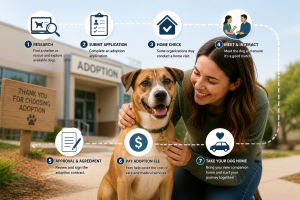
When you ask yourself what happens once you have decided to adopt a dog, this is where the actual process begins. Although the rules applicable in each shelter or rescue may vary slightly, the general dog adoption procedure in the USA is structured similarly.
The Adoption Application
After locating a dog that you are interested in, the first step is to fill out an application.
This typically includes:
• Personal details (name, address, contact details)
• Living conditions (house/apartment, owning or not)
• Pet History (pets or pets at present)
• Lifestyle information (work schedule, level of activity)
• References (sometimes required)
The idea is not to make it hard- just to make sure the dog is put in a safe and appropriate home.
Hint: Share the truth and be precise. Unfulfilled or incomplete responses may postpone approval.
This typically includes:
• Personal details (name, address, contact details)
• Living conditions (house/apartment, owning or not)
• Pet History (pets or pets at present)
• Lifestyle information (work schedule, level of activity)
• References (sometimes required)
The idea is not to make it hard- just to make sure the dog is put in a safe and appropriate home.
Hint: Share the truth and be precise. Unfulfilled or incomplete responses may postpone approval.
Screening/Interview Process.
Once you have applied to a shelter or rescue, most of them will carry out a screening. This may include:
• Interview (phone or video).
• Some questions regarding your expectations and experience.
• Talk about the needs and behavior of the dog.
A few of the questions that you may be asked are:
• What will you do with the training?
What will you do in case of the behavioral problems of the dog?
• In the number of hours the dog will be left alone per day?
This is a very important phase in the dog adoption process, as organizations want to minimize the risk of dogs being returned.
• Interview (phone or video).
• Some questions regarding your expectations and experience.
• Talk about the needs and behavior of the dog.
A few of the questions that you may be asked are:
• What will you do with the training?
What will you do in case of the behavioral problems of the dog?
• In the number of hours the dog will be left alone per day?
This is a very important phase in the dog adoption process, as organizations want to minimize the risk of dogs being returned.
Home Visit (Not Always required)
Other rescues, particularly foster-based rescues, might also request a home visit.
This can be:
• In-person
Virtual (through video call)
They normally test:
Safe environment (no hazards)
• Sufficient room for the dog.
• Fencing (where applicable) security.
There is nothing to worry about–this is not where we judge how you live. It is just to make sure that the dog is secure.
This can be:
• In-person
Virtual (through video call)
They normally test:
Safe environment (no hazards)
• Sufficient room for the dog.
• Fencing (where applicable) security.
There is nothing to worry about–this is not where we judge how you live. It is just to make sure that the dog is secure.
Approval and Waiting Period.
After screening, you will be given a go-ahead, but adoption is not necessarily instant.
There may be:
• Waiting list (particularly of popular dogs)
• Additional paperwork
• Liaison with foster families.
The time to give approval may be a few days or a few weeks.
⁻ One of the most effective tips for adopting a dog is to remain patient and flexible. It is worth waiting to get the right match.
There may be:
• Waiting list (particularly of popular dogs)
• Additional paperwork
• Liaison with foster families.
The time to give approval may be a few days or a few weeks.
⁻ One of the most effective tips for adopting a dog is to remain patient and flexible. It is worth waiting to get the right match.
Finalizing the Adoption
Once all is accepted, you will have to complete the last steps:
• Sign an adoption contract
• Have adoption fee paid.
• Receive medical records
• Get knowledge about the routine and behavior of the dog.
At this point, the dog is now officially a member of your family.
• Sign an adoption contract
• Have adoption fee paid.
• Receive medical records
• Get knowledge about the routine and behavior of the dog.
At this point, the dog is now officially a member of your family.
Step 5: Prepare Your Home to have a dog.

It is necessary to prepare before you take your dog home. A properly made home is a de-stressing factor for your pet and a helping factor in making your pet adapt more quickly.
To have a really easy introduction, it is as necessary to learn how to prepare a home for a dog as it is to adopt one.
To have a really easy introduction, it is as necessary to learn how to prepare a home for a dog as it is to adopt one.
Dog-Proof Your Home
Dog-proofing is needed, just as baby-proofing, and is particularly necessary when the dog is quite inquisitive or active.
The following are what should be checked:
• Get rid of poisonous plants (e.g., lilies, aloe vera)
• Hide electrical wires and cables
• Keep cleaning chemicals in the store in a safe place.
• Store small objects where they are not accessible.
Dogs use their mouths to explore, so anything within reach can pose a risk.
The following are what should be checked:
• Get rid of poisonous plants (e.g., lilies, aloe vera)
• Hide electrical wires and cables
• Keep cleaning chemicals in the store in a safe place.
• Store small objects where they are not accessible.
Dogs use their mouths to explore, so anything within reach can pose a risk.
Essential Supplies Checklist
Your dog has not yet arrived, and before he comes, make sure that you have the basics ready.
Must-have items:
Food and water bowls.
• High-quality dog food
• Collar with ID tag
• Leash and harness
• Comfortable bed
Crate (not a requirement, but a good idea)
Toys: (chew toys, interactive toys)
Being prepared with these things will demonstrate responsibility and will be a smoother transition.
Must-have items:
Food and water bowls.
• High-quality dog food
• Collar with ID tag
• Leash and harness
• Comfortable bed
Crate (not a requirement, but a good idea)
Toys: (chew toys, interactive toys)
Being prepared with these things will demonstrate responsibility and will be a smoother transition.
Develop a Safe Space.
It will take some time for your dog to settle into his new surroundings.
Create a special environment where they can feel safe, and these may include:
• A quiet corner
• A bedding-crate.
• A designated room
This room will help your dog calm down and eliminate anxiety in the first couple of days.
This is one of the least considered tips for adopting a dog, but it is very important for early behavior.
Create a special environment where they can feel safe, and these may include:
• A quiet corner
• A bedding-crate.
• A designated room
This room will help your dog calm down and eliminate anxiety in the first couple of days.
This is one of the least considered tips for adopting a dog, but it is very important for early behavior.
Establish House Rules at the earliest.
When adopting a new dog, consistency is the most important aspect.
Decide in advance:
Where the dog is permitted (furniture, rooms)
• Feeding schedule
• Walking routine
Who is to be taken care of?
When you live with the family, everybody must obey the same rules, so as not to confuse the dog.
Decide in advance:
Where the dog is permitted (furniture, rooms)
• Feeding schedule
• Walking routine
Who is to be taken care of?
When you live with the family, everybody must obey the same rules, so as not to confuse the dog.
Make Your Family Ready (And Other Pets).
Preparation is important if you have other pets or family members.
For families:
• Show children how to treat dogs without any alarm.
• Do not make any loud or sudden movements at first.
For other pets:
• Slow and controlled early interactions.
• Allow gradual introductions
A stress-free or conflict-free environment can be achieved with a controlled environment.
For families:
• Show children how to treat dogs without any alarm.
• Do not make any loud or sudden movements at first.
For other pets:
• Slow and controlled early interactions.
• Allow gradual introductions
A stress-free or conflict-free environment can be achieved with a controlled environment.
Some of the typical errors that should be avoided during this stage are:
Despite the good intentions, the first-time adopters have to make some mistakes that could be avoided:
• Hurrying on the adoption process.
• Failure to completely understand requirements.
• Taking a dog home unprepared.
• Purchase of supplies once the dog is bought.
• Not recognizing the significance of routine.
These errors can be greatly avoided to enhance your experience.
• Hurrying on the adoption process.
• Failure to completely understand requirements.
• Taking a dog home unprepared.
• Purchase of supplies once the dog is bought.
• Not recognizing the significance of routine.
These errors can be greatly avoided to enhance your experience.
— Part 3
Introduction to Part 3
Up to this point, you have learned:
• How to determine whether you are prepared to have a dog.
• What to do to get the correct breed of a dog.
Where and how the dog adoption process is carried out.
• How to prepare your home to take in a dog beforehand.
The most thrilling (and in some cases nerve-wracking) part is now coming, bringing your dog home and helping them to adapt to their new home.
And this last section will help you through Steps 6 and 7, as well as some of the most common mistakes, cost breakdowns, and frequently asked questions to thoroughly prepare you to succeed.
• How to determine whether you are prepared to have a dog.
• What to do to get the correct breed of a dog.
Where and how the dog adoption process is carried out.
• How to prepare your home to take in a dog beforehand.
The most thrilling (and in some cases nerve-wracking) part is now coming, bringing your dog home and helping them to adapt to their new home.
And this last section will help you through Steps 6 and 7, as well as some of the most common mistakes, cost breakdowns, and frequently asked questions to thoroughly prepare you to succeed.
Step 6: Take Your Dog at Home.
Taking your dog home is a big occasion; however, it is important to keep things relaxed and under control. The first several days may define your dog’s behavior patterns and long-term level of comfort.
The First Day at Home
Your dog can be overwhelmed, scared, or confused. All is new, the smells, people, and environment.
What you should do:
• Maintain a quiet and peaceful environment.
• Restrict the number of visitors on the first day.
• Let your dog explore the world at his own pace.
Avoid forcing interaction. Allow the dog to approach you when they are comfortable.
Among the most significant tips for adopting a dog is: do not hurry up with bonding–it will take time.
What you should do:
• Maintain a quiet and peaceful environment.
• Restrict the number of visitors on the first day.
• Let your dog explore the world at his own pace.
Avoid forcing interaction. Allow the dog to approach you when they are comfortable.
Among the most significant tips for adopting a dog is: do not hurry up with bonding–it will take time.
How to introduce your dog to the family.
Correct introductions can help establish trust and reduce stress.
Best practices:
• One by one, introduce a person.
• Allow the dog to come in the first place.
• Stay on low tones or make sudden movements.
Provided you are a parent, instruct your children to:
• Be gentle
• Do not embrace or surround the dog.
• Keep within the space of the dog.
Best practices:
• One by one, introduce a person.
• Allow the dog to come in the first place.
• Stay on low tones or make sudden movements.
Provided you are a parent, instruct your children to:
• Be gentle
• Do not embrace or surround the dog.
• Keep within the space of the dog.
Introducing Other Pets
If you already have pets, introduce them gradually and keep them under control.
Steps to follow:
• Begin with scent exchange (blankets, toys)
• Introduce somewhere in the middle (such as a park)
• Initially, have both animals on a leash.
Pay attention to the stress symptoms, such as:
• Growling
• Stiff body posture
• Excessive barking
The most important aspect during this stage is patience.
Steps to follow:
• Begin with scent exchange (blankets, toys)
• Introduce somewhere in the middle (such as a park)
• Initially, have both animals on a leash.
Pay attention to the stress symptoms, such as:
• Growling
• Stiff body posture
• Excessive barking
The most important aspect during this stage is patience.
Develop a Routine as soon as possible.
Dogs do well with consistency. A regular routine will make them feel safe.
Set a schedule for:
• Feeding times
• Walks and exercise
• Bathroom breaks
• Sleep
Consistency decreases anxiety and accelerates training.
Set a schedule for:
• Feeding times
• Walks and exercise
• Bathroom breaks
• Sleep
Consistency decreases anxiety and accelerates training.
First Vet Visit
Although your dog may already have been taken to the vet, it is important to take it again.
Your vet will:
• Do a complete health examination.
• Review vaccination records
• Recommend preventive care
It is also an opportune moment to create and discuss plans for diet, behavior, and long-term health.
Your vet will:
• Do a complete health examination.
• Review vaccination records
• Recommend preventive care
It is also an opportune moment to create and discuss plans for diet, behavior, and long-term health.
Step 7: Assist Your Dog to settle and flourish.
After your dog is at home, the real journey begins. Adaptation does not take place in a single day; it may take weeks or even months.
Rudimentary Education and Punishment.
A well-behaved dog can only be achieved through training.
Start with:
• House training
Basic commands (sit, stay, come)
• Leash training
Use positive reinforcement:
• Treats
• Praise
• Consistency
Do not punish–it may destroy confidence and cause fear.
The most effective tip on adopting a dog: Reward good behavior, and punish bad behavior.
Start with:
• House training
Basic commands (sit, stay, come)
• Leash training
Use positive reinforcement:
• Treats
• Praise
• Consistency
Do not punish–it may destroy confidence and cause fear.
The most effective tip on adopting a dog: Reward good behavior, and punish bad behavior.
Socialization Is Key
It is a good idea to socialize your dog to help avoid fear and aggression.
Gradually introduce your dog to:
• New people
• Other dogs
• Different environments
Begin with slow exposure and gradually increase it as your dog becomes familiar with it.
Gradually introduce your dog to:
• New people
• Other dogs
• Different environments
Begin with slow exposure and gradually increase it as your dog becomes familiar with it.
Building Trust and Bonding
Building trust is a long process, especially with rescue dogs.
To develop a healthy connection with each other, you can:
• Quality time every day.
• Patience and being calm.
• Maintaining consistent routines
Your relationship can be strengthened through simple activities like walks and playtime.
To develop a healthy connection with each other, you can:
• Quality time every day.
• Patience and being calm.
• Maintaining consistent routines
Your relationship can be strengthened through simple activities like walks and playtime.
Managing typical Adjustment Problems.
Most adopted dogs experience initial difficulties.
Common issues include:
• Separation anxiety
• Excessive barking
• Chewing furniture
• Fearful behavior
How to handle them:
2. Be patient and regular.
• Mentally stimulate (toys, puzzles)
• Professional training sought as necessary.
It should be remembered that, in most cases, these behaviors are only temporary and get better with time.
Common issues include:
• Separation anxiety
• Excessive barking
• Chewing furniture
• Fearful behavior
How to handle them:
2. Be patient and regular.
• Mentally stimulate (toys, puzzles)
• Professional training sought as necessary.
It should be remembered that, in most cases, these behaviors are only temporary and get better with time.
These are common mistakes to avoid when adopting a dog.
Despite being prepared, errors might occur. Their knowledge of them can be of much use to you.
These are some of the pitfalls that should be avoided:
• Using the looks of the dog as the only criterion.
• Not paying attention to energy levels and temperament.
• Skipping training
• Not budgeting properly
• Expecting instant bonding
Learning how to adopt a dog in USA also implies not doing everything.
These are some of the pitfalls that should be avoided:
• Using the looks of the dog as the only criterion.
• Not paying attention to energy levels and temperament.
• Skipping training
• Not budgeting properly
• Expecting instant bonding
Learning how to adopt a dog in USA also implies not doing everything.
The cost breakdown of the dog adoption in the USA.
Most individuals think that adoption is inexpensive; however, it still requires financial planning.
Initial Costs:
• Adoption fee: $50–$500
• Supplies (bed, leash, toys): $100–$300
• Initial vet visit: $50–$200
Monthly Costs:
• Food: $30–$100
• Grooming: $20–$80
• Regular vet check-up: varies.
Unexpected Costs:
• Emergency vet visits
• Behavioral training
• Medications
Making a fit means you will be able to offer regular care.
Initial Costs:
• Adoption fee: $50–$500
• Supplies (bed, leash, toys): $100–$300
• Initial vet visit: $50–$200
Monthly Costs:
• Food: $30–$100
• Grooming: $20–$80
• Regular vet check-up: varies.
Unexpected Costs:
• Emergency vet visits
• Behavioral training
• Medications
Making a fit means you will be able to offer regular care.
Frequently asked questions regarding adopting dogs in the USA.
How many days does the dog adoption process take?
Depending on the shelter or rescue, it will require a few days to a couple of weeks.
Do I live in an apartment and can adopt a dog?
Yes, lots of dogs can live in apartments – smaller dogs, lazy dogs.
Will it be cheaper to adopt a dog than to purchase one?
Yes, adoption is typically cheaper and covers medical treatment such as vaccinations and spaying/neutering.
What documents are needed to be adopted?
Generally, an ID, an attestation of residence, and, if you rent, landlord permission.
Is it possible to give back a dog that has been adopted?
The majority of the shelters have returns, but it is better to dedicate oneself to it and to avoid that situation.
Ultimate Findings: Begin Your Dog Adoption Process Today.
Adopting a dog is not just about bringing home a pet; it is more like bringing home a lifetime companion to your family.
Through this 7-step guide on how to adopt a dog in USA, you have come to realize:
• The complete dog adoption procedure.
• How to select the appropriate dog.
How to prepare a home for a dog.
• How to help your dog adjust and develop.
All dogs need a good home–and, with proper preparation, you can offer them just that.
Through this 7-step guide on how to adopt a dog in USA, you have come to realize:
• The complete dog adoption procedure.
• How to select the appropriate dog.
How to prepare a home for a dog.
• How to help your dog adjust and develop.
All dogs need a good home–and, with proper preparation, you can offer them just that.