

 By
By Introduction.
Training your dog is one of the most important responsibilities of being a pet owner. A trained dog is happier, safer, and more confident, and is easier to handle. For puppy or older dog training, it is important to master the basics step by step, which can tremendously improve your day-to-day life.
Trusted communication has been the primary objective of Dog Training in the USA for the past few years, rather than punishment.
Modern dog owners are more interested in humane, effective, and easy-to-apply techniques that can be used at home.
The big plus is that you don’t have to be a certified trainer to teach your dog good behavior. With a little practice and consistency, it’s possible to teach a dog with simple tools and patience.
In this complete guide, you’ll learn:
The step-by-step training methods for beginners are available.
Use a basic dog commands list to help you understand how to teach the key commands.
Remind children that they should respect others, their peers, and staff, cooperate with them, and leave things tidy.
Practical skills such as dog fast potty training
At the end of this guide, you’ll know exactly what steps to take in order to begin training your dog with confidence, even if you’re a beginner.
Before you train your dog, you should know them first. Learn about your dog before training.
It is essential to know how your dog thinks and learns before you start training. Training doesn’t have to be just about commands; it’s about communication, trust, and consistency.
How Dogs Learn
Dogs learn primarily through:
Once you have read the boxes, have the children repeat the same action. When children have read out the boxes, repeat the action several times.
Rewards or consequences are associated with actions (Association)
Tone of voice – responding to the way you deliver it.
When you say “Sit” and add a reward to the behavior, for instance, a treat, your dog starts to make the connection between the word and the behavior and the reward.
One of the most effective methods of dog training in the USA today is positive reinforcement, which rewards good behavior. Dogs will more readily repeat behavior that is followed by a reward.
Age and Breed Differences
Dogs don’t have to learn at the same rate. There are several factors to consider when training:
Puppies
Have a rapid learning curve, but cannot hold things in their mind for long
Need to have short training sessions often
Adult Dogs
May need to remove bad habits that are hard to break
Even with regular training, one can be retrained effectively.
Breed Differences
There are breeds that are easier to train:
• Very good to train: Border Collies, Labradors, German Shepherds
When choosing a dog, keep in mind that some breeds are more independent than others, such as huskies and Bulldogs (which may require more patience).
Knowing your dog’s temperament can help you tailor your training techniques.
Setting Realistic Expectations
You would be making one of the biggest blunders if you thought that anything would work overnight. Dog training is a step-by-step process.
Keep in mind:
Ongoing training is necessary, and repetition is the key to success.
Errors are a normal part of learning
Beware of rushing through anything – consistency is more important than speed.
Don’t strive for perfection; focus on taking gradual steps each day. This attitude will streamline and enhance your training experience.
Preparing for Dog Training at Home means preparing to train your dog at home.
You’ve now learned what your dog is doing; you need to make your home a training environment. Setting up the right environment will help you with a step-by-step dog training program for beginners.
Essential Training Tools
It is not necessary to have a lot of expensive equipment to begin training your dog. Basic tools include:
Rewards – small, soft, easy to eat treats
• Leash collar – to control and keep him safe
Clicker (optional) – for very specific training signals
• Toys – can also be used as rewards
Rewards are crucial at the beginning because your dog will learn quickly when he is motivated.
Designing a training program for a team.2.1 Designing a training program for a team.
A great training area can boost your dog’s concentration.
Select a space that is:
• Quiet and free from distractions
• Safe and comfortable
• Familiar with your dog
It’s best to begin your training indoors when you’re a novice dog owner, learning how to train a dog. After your dog shows improvement, you can start adding in distractions such as the outdoors.
Setting up a Daily Routine
Routine is crucial for dogs. They will have a routine to follow, which will help them to know what to expect and when.
Your daily schedule should be:
• Feeding times
• Potty breaks
• Training sessions
• Playtime
For example:
Morning: Potty + brief training session.Morning: Potty + short training.
It is recommended that learning be split into two afternoon sessions: Play + reinforcement training.
Evenings: Review of commands + calming activities
A dog potty training routine is particularly beneficial for quickly potty training a dog, since dogs tend to learn to associate certain times with the need to go outside to relieve themselves.
Setting Training Goals
Determine what you would like your dog to learn first.
Start by setting health goals, such as:
• Responding to their name
• Learning “Sit.”
• Basic obedience
Small-step training breaks make it easier to monitor progress and motivation.
Conclusion of Part 1
This is the first half of the successful dog training basics:
• The significance of training and modern techniques of Dog Training in the USA
Understanding the basics of dog training and the importance of behavior.Important aspects of dog learning and the significance of behavior.
How to set your house up and design your training program.How to get your house ready and how to design your training program.
These fundamentals will come before any real training techniques.
If you are a novice dog trainer, these 10 dog training tips will help you get started.
In Part 2, the core training steps, basic commands, and potty training will be covered.
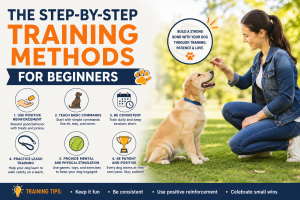
Tip #1: Begin using simple instructions.
The first step in being a dog training beginner step by step is to teach your dog the fundamentals of dog obedience. These are some basic commands you need to teach your pet so they understand you.
A well-trained dog can follow basic commands, making them safer and more well-behaved in the house and out.
Basic Commands are important for a reason!
Basic commands help:
Handle your dog in a variety of situations
• Prevent unwanted behavior
Ensure that trust and communication are established.
Keep your dog safe in public areas
A basic command, such as “Come,” might be used to stop your dog from getting into trouble.
A list of the most basic dog commands.
These are the most basic commands that every beginner needs:
Sit is a calming and attention-seeking signal to the dog.
Stay – Remains in place
Come – Bring your dog back to you when they are called by their name/calls
• Down – Relaxes the animal.
Heel – Helps your dog to walk in the heel position.
• Leave it – Avoids picking up harmful objects
This is a basic list of dog commands that is the beginning of all good training!
Step-by-Step to Teach “Sit”
Sitting is typically the most straightforward exercise to teach.
2. Place a treat close to your dog’s nose.
Slowly move your hand up
3. You will see your dog lower his butt as he moves the treat.
Say “Sit” clearly once they have landed in a sitting position.
5. Immediately reward with a treat and praise
Continue this daily for 14 days, each day. To help your dog understand and remember, you need to be consistent.
Tip #2: Use Positive Reinforcement
Positive reinforcement is one of the best methods used in today’s Dog Training in the USA. This approach is based on the principle of positive reinforcement instead of negative reinforcement or reprimands.
How Positive Reinforcement Works
Reward your dog with:
• Treats
• Demonstrating understanding by repeating what the student said
• Toys or playtime
This helps build a positive connection, making them more likely to do it again.
Why Avoid Punishment
Punishing your dog can:
• Provoke unhappiness and worry
• Damage trust
• Lead to aggressive behavior
Rather, it’s about teaching your dog what to do and rewarding success.
Tip #3: Make The Training Session Rewarding
Many make the mistake of overtraining when starting out. Dogs are not known for being long-lasting.
Ideal Training Duration
Each session = 5 to 10 minutes
• 2–3 sessions per day
Short sessions keep your dog focused and help avoid frustration.
Consistency Over Length
You should do these for a few minutes at a time, rather than once a week for a long period. Practice helps to reinforce and establish habits more quickly.
Tip #4: Be consistent with commands:
One of the most crucial components of successful training is consistency.
For any given word, the spelling is the same. Each word has the same spelling.
Your dog might get confused if you use different words for the same command.
For example:
Only use “Sit”, not “Sit” or “Sit down” or “Down.”
Family Consistency Matters
The same commands and rules should be used throughout the family. Ambiguous training can hinder progress.
Consistency Builds Confidence
Your dog can feel more confident and better respond to commands when it knows what to expect.
With #5, you will receive a potty-training schedule for your dog.
Mastering how to train a dog to pee and poop quickly is among the primary worries of puppy owners. If you have the right routine and are consistent, you can train your dog in a short period of time.
The importance of routine.
Dogs do learn by repetition. They know when and where to go when there is a consistent schedule.
The best times to take your dog for a walk:
• Early morning
• After meals
• After naps
• Before bedtime
Step-by-Step Potty Training Method
2. Select a particular location
Always go to the same place with your dog.
2. Use a command
Repeat, e.g., “Go potty” every time.
3. Wait patiently
Allow your dog time to eliminate
4. Reward immediately
Celebrate and reinforce the right behavior immediately following
5. Repeat consistently
Do the same exercise routine each day.
To get results even faster, follow these tips:
Walk your dog often (pup dogs every 2-3 hours)
Look for signs such as sniffing or circling
Schedule feedings to anticipate when the puppy will need to go out to eliminate (pee or poop)
Common Mistakes to Avoid
- Accident punishment – results in fear, not learning
• Unpredictable behavior – Confuses your dog
Do not reward success – decreases motivation
Keep in mind that accidents will happen. Be patient and persistent.
Conclusion of Part 2
We briefly reviewed the fundamental training methods every beginner should be able to perform:
• Training the dog basic commands given in a basic dog commands list
The use of positive reinforcement for better results.
• Maintaining the session to be as brief as necessary and as effective as possible
Involves ensuring that no inconsistencies arise in the training process.Requires consistency during training.
Without any doubt, a dog training method that has been tried and tested for potty training.
These are the core steps of dog training for beginners, presented step by step, to help your dog succeed.
Here are 10 dog training tips for beginners (step-by-step guide):
Part 3: Advanced Training Tips, Step by Step Plan, Mistakes & FAQs
You’ll find some good crate training basics in Tip #6.
One of the best methods in Dog Training in the USA, particularly for novices on how to train a dog at home, is crate training. The crate gives your dog a secure, comfortable den of his own.
Why Crate Training is Important
Crate training helps:
Provide a safe night’s sleep spot
• Prevent destructive behavior
Give encouragement to the potty training dog promptly
Put routines and discipline in place
Dogs have a natural need to have a den of some sort, and a crate can turn into a dog’s comfort zone if handled correctly.
Crate Training (how to start):
- Select right-sized crate (not oversized or undersized)
- Put soft bedding and toys in
- Allow your dog to investigate the crate at his own pace.
- Remove the crate after only a few minutes. 6. After a few minutes, take the crate away.
- Make crates progressively more difficult to access. 7. Increase crate time gradually.
Do not force a dog inside—this can make him lethargic. To create a positive space in the crate.
Tip #7: Early Socialization of your Dog
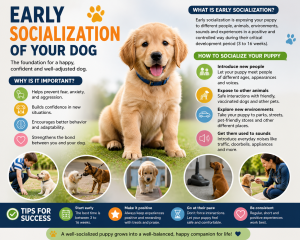
Socialization is a critical component of raising a well-behaved, confident dog. It includes introducing your dog to various people, places, and other animals.
Benefits of Socialization
Inhibits fear and anxiety
• Prevents aggression
• Develops social skills in public areas
A well-socialized dog will be more relaxed and adaptable.
The title of this chapter is “How to Socialize Your Dog.”
Allow your dog to slowly get acquainted with new people
Go to parks and pet-friendly places
Set up playdates with other dogs to help them get acquainted.
Expose them to a variety of sounds and contexts
Socialization should begin as early as possible; however, it’s not too late for adults to be socialized with patience.
Tip #8: Train Your Dog to Walk on a Leash
Social media training is very important for outdoor play. If not properly trained, a dog could pull, jump, or become hard to handle.
Steps for Leash Training
Attach the leash and allow your dog to get accustomed to it.
2. Walk in a quiet place
Reward your dog for walking on your left side.
If your dog is pulling, STOP walking.
Wait until they come to you before you resume.
Consistency is essential to teaching good leash manners.
Make sure you don’t make any of these common leash training mistakes.
• Pulling back aggressively
Learning to use long or retractable leashes in the beginning
Recommendations:
Patience and repetition will help your dog learn faster.
Rule #9: Correct Bad Behavior Properly
All dogs exhibit undesirable behaviors at some point. The important thing is to fix it in a beneficial and effective manner.
How to respond to negative behavior.
Correct your dog’s behavior and redirect it to a more appropriate behavior.
Ignore attention-seeking bad behavior
Immediately reward good behavior.
If your dog chews on furniture, for instance, give them a chew toy and reward them for using it.
Avoid Negative Reinforcement
Punishment can:
• Create fear
• Damage trust
Encourage bad behavior
Rather, concentrate on training what your dog must do.
Tip #10: Patience and positivity!
The key to successful training is patience. Learning is unique to each dog, and some may need time to learn.
Why Patience Matters
Establishes a relationship of trust with your dog
• Encourages consistent learning
• Fosters mutual harmony and enjoyment between owner and pet
Praise minor progress: answering an instruction, showing improvement.
There is a Step-by-Step Dog Training Plan for every situation.
So, if you’re looking to teach a dog training step by step, here is an easy dog training beginner’s step-by-step training plan for four weeks.
Week 1: Build the Basics
Tell your dog his or her name.
• Start with the “Sit” command
Start routine for feeding and using the toilet
Week 2: Add Control Commands
Introduce the words “Stay” and “Come” to them.
• Continue reinforcing “Sit.”
• Begin short leash walks
Week 3: Expand Training
Work on leash skills outside of the house.
• Introduce crate training
• Improve potty habits
Week 4: Strengthen Behavior
• Combine commands
The counselor will work on behavior correction.
• Increase distractions gradually
This structured approach makes dog training at home much more effective.
Here are some of the most frequent dog training errors:
With the most enthusiasm, a beginner can make errors that impede progress.
Inconsistency
Multiple commands or routines confuse your pooch.
Lack of Patience
Looking for instant results will cause frustration.
Overtraining
Extended sessions may leave your dog feeling overwhelmed.
Using Punishment
Negative methods undermine trust and learning.
Ignoring Good Behavior
Reward good behavior to consolidate learning.
A Q&A on dog training.
Q1. What is the time required for dog training?
Training can be a few weeks to a few months, depending on the dog’s age and breed, as well as the consistency of training.
Q2: May I train my dog from home?
Yes, it is possible to teach a dog at home, even for novices, with the right methods and consistency.
I would say the easiest command to teach is the one that you have the most success with.
Sit” is typically one of the first and most basic of any dog training command list.
Q4: How to potty train my dog quickly?
Stick to a strict routine, potty your dog regularly, and reward him as soon as he gets outside.
Final Conclusion
Training a dog isn’t as complicated as it may seem. These 10 tips will help you train your dog with the right steps, making it clear and effective for beginners.
Each stage progresses to a well-behaved and happy pet, from basic commands to learning to go on the leash and correct their behavior.
Remember:
• Be consistent
• Stay patient
• Use positive reinforcement
The basic principle of Dog Training in the USA, or dog training at home, is that attention and love are needed.
You’ll find your dog’s behavior and your relationship with your dog amazing in no time!