

 By
By Introduction
German Shepherd Dog (GSD) is the most intelligent, loyal and hardworking dog breed in the world. This breed was originally used in Germany to shepherd sheep but today, it is the worldly representation of power, discipline and security. It is one of the best working dogs that have been preferred by security forces, families and professional trainers due to its sharpness of mind, strong physical body and guard instincts. The German Shepherd is admired as a pet and a working partner of high abilities worldwide.
One of the main reasons behind the popularity of this breed is its versatility. German Shepherd can readily fit into various functions including protecting the family, search and rescue, detection, and law enforcement. GSDs are also common in most security agencies where they can master commands quickly, react during pressure and are able to remain focused even in difficult situations. That is why Dog Training GSD is regarded as one of the most significant processes to all the people who own or work with this breed.
German shepherds are also a significant contributor to police and military activities. They are usually employed in patrol work, following criminals, identifying any explosives or drugs, and managing dangerous scenarios. Their bravery and orderliness qualify them to hazardous duties where human life can be jeopardized. Indeed, contemporary training of police dogs is extensively dependent on German Shepherds because of their high level of nerves and promptness in decision-making.
But these great powers are not acquired without effort. Proper training from an early age is extremely important. In the absence of formal training, a German shepherd can grow up too aggressive, nervous or uncontrollable. Early training in obedience assists in shaping their behavior, instills confidence between the dog and the handler and makes sure that their natural energy is channeled in a good and controlled manner. Successful training is based on consistency, patience, and proper guidance.
Protection dog skills are another important aspect of GSD development. Such skills are controlled guarding, threat detection, alert barking, and responding to commands in stressful situations. The trained protection dog is not a ferocious animal, he is simply a trained, alert and controlled animal, ready to obey the commands of the trainer. It is this combination of protection and obedience that makes German Shepherds the best working dogs.
This article will discuss some of the most effective protection training tips that will enable you to change a German Shepherd into a dependable working mate. Be it a personal security or a professional tool, the answer to creating a good, well-behaved and confident protection dog lies in the fundamentals of Dog Training GSD and organized police dog training.
Learn about the German Shepherd Temperament
The character of a German Shepherd Dog (GSD) is one of the most significant aspects that makes this type of working dogs unique among the others. They are innately clever, very vigilant, and very faithful to their masters. This is a combination of characteristics that make them fit best in security jobs, protecting the family, and working environments. Their temperament should however be understood after which they should be under any serious training program like Dog Training GSD.
German Shepherds are highly motivated workers. This does not imply that they are only active dogs, but that they like to have tasks, challenges and responsibilities. They may get bored without proper mental and physical stimulation and this can result in undesired behaviors like excessive barking or destructive behaviors. This is why a well-organized protection dog training is so necessary in order to make them focus their inherent energy in the correct direction.
Intelligence is one of the most amazing traits of GSDs. They are fast learners and they comprehend instructions with few repetitions. This has seen them being extensively used in the enforcement of the law and even in the military. Indeed, the training of police dogs in most countries is inclined towards German Shepherds due to the ability to learn complicated commands and work in the real world easily. They are very effective in critical missions as they can analyze situations and act on them.
Another important aspect of their personality is loyalty. German Shepherd creates a strong emotional bond with its handler or family. This relationship is significant in effective training since a dog that has trust in its owner will have a higher chance of obeying commands correctly and consistently. At Dog Training GSD, the initial stage before progressing to advanced protection or guarding skills is to build trust.
At the same time, German Shepherds have a natural protective instinct. They are inherently sensitive to the environment, and can easily pick up something out of the ordinary or danger. This instinct renders them good guard dogs, but this needs to be well checked by good training. This protective nature may result in unwarranted aggression without discipline. Thus, the training of the protection dogs follows a structure that makes sure that the dog responds only when necessary and it is calm in usual circumstances.
A significant trait of this breed is energy level. German Shepherds need frequent workouts, to be engaged in the mind, and meaningful tasks. The dog that is well exercised is easier to train and more attentive during the training sessions. Conversely, an untrained or poorly trained GSD can have problems with compliance and discipline.

Overall, the German Shepherd is an intelligent, loyal, energetic, and protective dog with a strong temperament. With the right directional training of these inherent characteristics, these natural endowments can be molded into superior working skills that have made the German Shepherd one of the most competent protection dogs in the world through Dog Training GSD and professional training of police dogs.
Obedience Training Fundamentals Before Protection Work.
The best preparatory step to take prior to the commencement of any advanced protection or security training is the establishment of a good foundation of obedience with the German shepherd. Without acquiring the fundamental discipline and control, a dog will not be able to do any sound protection work. It is due to this reason that all professional programs of Dog Training GSD will always start with obedience training as the fundamental step.
The obedience training will show the dog to comprehend and react to simple commands like sit, stay, come, down and heel. All these commands are not mere tricks; these are the language of communication between the dog and the handler. In the field where real work can be done, such as security patrols or law enforcement operations such commands can be the difference between order and anarchy. This is the reason why whenever training a police dog, a lot of emphasis is laid on their absolute obedience first before any form of protection skills are introduced to them.
One of the main goals of obedience training is to build respect and trust between the German Shepherd and its handler. The dog has to be trained to concentrate on the handler despite distractions. This concentration is built by repetitions, consistency, and positive reinforcement. Treats, praise or play are some of the rewards that make the dog realize that acting on instructions gives good results.
Impulse Control is another significant aspect of Dog Training GSD. German shepherds are inherently active and motivated; therefore, it is possible that they respond suddenly to movement, noise or unrecognized people. Obedience training makes the dog learn to be patient and to have self-control. As an example, training a dog to wait until given food or to remain stationary until given a command develops mental discipline, necessary for training a dog to higher protection levels in the future.
Some common errors that many owners commit at this level are giving the inconsistent commands, being patient or employing punishment in place of systematic training procedures. Cruel practices may hurt the trust and become less receptive to the dog. Police dog trainers emphasize calm power and effective communication more than aggression and disorientation in their professional training programs.
The training sessions are to be brief and frequent. German Shepherds respond to lessons that are well defined and repeated following a routine. Giving the dog excessive commands simultaneously may decrease concentration and slow the development. Learning one command at a time will make sure that the learning process is complete before proceeding to another level.
To sum it all, all successful Dog Training GSD programs are based on obedience training. Advanced protection work is not safely and effectively developed without vigorous obedience. It takes a trained German Shepherd first to achieve discipline, concentration, and trust before graduating to the police dog training or protection levels. Such a foundation guarantees the dog to be not only strong but also controlled, reliable, and safe under any circumstances.
Controlled Protection Socialization Skills
Socialization is the most significant and probably the neglected aspect of Dog Training GSD, particularly when training a German shepherd as a security or protection dog. A socialized dog is assured, relaxed and can make balanced judgment in various settings. Even a well trained dog without proper socialization would turn out to be over reactive, fearful or unpredictable.
The key aim of socialization is to make the German Shepherd encounter a great diversity of people, places, sounds, and scenarios at the initial stage of development. This will enable the dog to know what is normal in the day-to-day life and what could be a threat. Professional police dog training always consists of socialization, first, then commences any serious protection or tactical training.
When a GSD is well socialized, it knows how to be calm in the presence of strangers, children, other animals, and in the presence of people and other animals in the streets, markets or training field. This does not lessen its protective instincts; it rather increases its capacity of differentiating between normal and dangerous situations. This balance is critical in successful protection dog training, and control is more significant than aggression.
Lessening fear-induced responses is one of the advantages of socialization. A dog that has not been subjected to other environments might be aggressive due to fear or confusion. Exposure early gains confidence and makes the dog remain calm in a stressful situation. To illustrate this, a well-socialized German shepherd will not run away at high-noise places like traffic, people, and training simulation that are applied in police dog training programs.
The other significant teaching point is the instruction of controlled behavior in social areas. The dog ought to be trained to walk on a leash without getting distracted, and follow orders with his objections when he is in the presence of noise and movement. Such discipline is critical in the real-life security work where attention should be at all times be on the handler.
Unnecessary aggression is also averted through socialization. Even a German Shepherd that has a keen sense of protection must know how to remain calm at times. In the absence of proper socialization, the dog can then be over protective and respond to dangerous situations. Structured Dog Training GSD assures that the protective behavior is only activated in case of a real threat.
Gradual exposure is the best thing to do. The trainers begin with easy environments and gradually become more challenging. Calm behavior is reinforced with positive reinforcement, which teaches the dog to relate the new experiences to the feeling of safety and confidence.
To sum up, any successful Dog Training GSD program should have socialization as a key pillar. It makes sure that the German Shepherd becomes a balanced working dog capable of coping with normal life and with high pressure situations. Socialization in professional police dog training and protection dog training is what turns the instincts to controlled, reliable, and intelligent protection behavior.
🛡️ Tip #1: Building Strong Handler Bond
The German Shepherd and its handler relationship is one of the strongest bases in Dog Training GSD. A dog will not be able to perform to its best capacity without a strong bond. This bond is regarded more significant than any single command in professional working conditions like security units and law enforcement. That is why any successful training program on k9 police dog training is initiated by the building of the trust between a dog and a handler.
German shepherd is an emotionally bonding species, yet this bond has to be molded and reinforced with day to day interaction. The person giving the commands is not the only one who should be the handler; he/she must also be the provider of food, play, guidance and reward. Once the dog starts perceiving the handler as a leader and provider, then obedience becomes instinctive and not induced. This emotional attachment enhances concentration, retention, and reaction rate, in training.
Routine activities contribute a lot to the development of this bond. Basic exercises like taking walks together, brief training, hand feeding and restrained play assist in enhancing the interaction between the dog and the handler. Such situations help the dog learn to listen to the body language, voice tone and commands of the handler. In Dog Training GSD, intensity is not as effective as consistency. Little things that are done everyday build trust that is long lasting.
Another critical method employed in home training, as well as professional k9 police dog training is positive reinforcement. Treats, praise or play should be used to reward the dog when it behaves well, and this will help the dog repeat the behavior. As time passes, the German Shepherd learns to comply with the commands of the handler by acting as a good dog. The approach instills trust and minimizes misunderstandings in the learning process.
Close relationship also enhances work in stressful or distracting conditions. A German shepherd is a dog that is able to stay calm even when in a strange environment as long as it has faith in its owner. It is particularly relevant to real-life security work, where expediency and compliance may be vital. Weak bond on the contrary may result in hesitation or loss of control.
It is also important for the handler to remain calm, consistent, and confident. Dogs are very sensitive to the moods of human beings, and when trained by a nervous or disjointed owner, confusion may occur. Leadership in Dog Training GSD does not imply aggression, but is rather a clear communication, patience and reliability.
To sum up, the most effective and powerful action in establishing a successful working German Shepherd is to establish a healthy handler bond. In either the home training or the advanced k9 police dog training, this bond is the basis of the obedience, protection skills, and long-term stability. An adequately attached GSD does not simply undergo training, he is bonded with his owner, and each command is more efficient and each task is more trustworthy.
🛡️ Tip #2: Bite Control Training in Dog
One of the most important aspects of the advanced Dog Training GSD would be the bite control when training a German shepherd to become a professional security or working dog. An uncontrolled powerful dog is quite dangerous whereas a well trained dog with controlled bite work makes an excellent protection companion. Aggression is not the primary objective of bite control, but rather discipline, accuracy, and obedience to command.
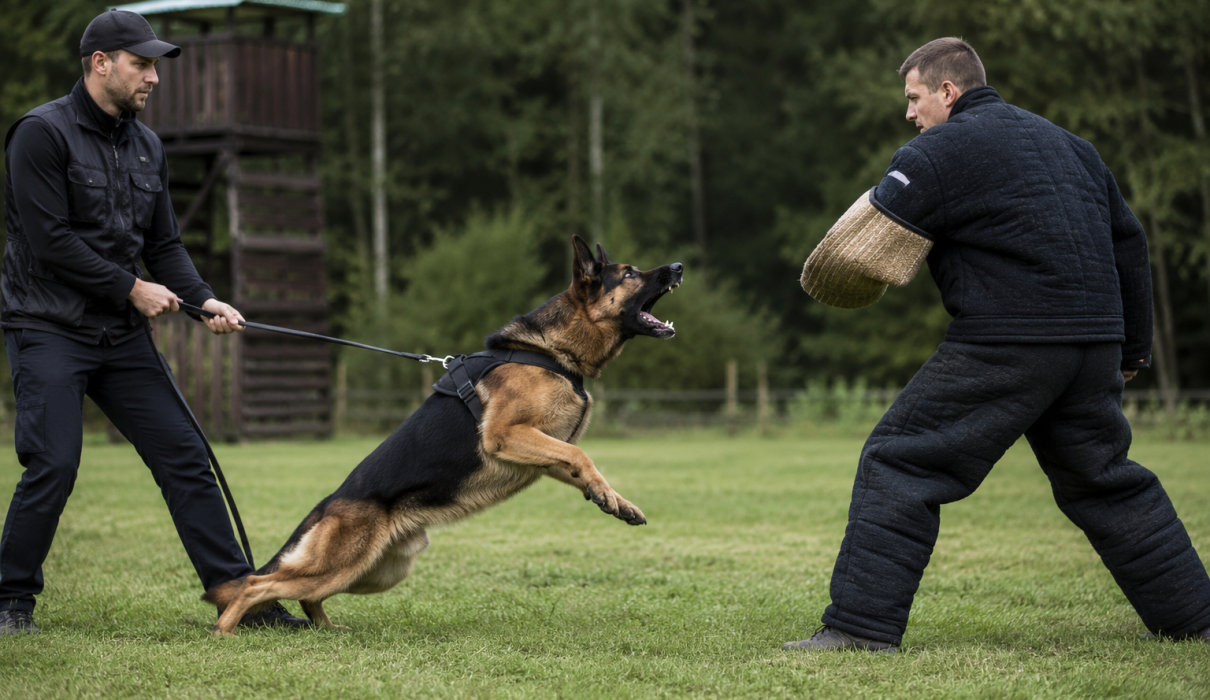
German Shepherds are also trained in professional training of police dogs to know when to attack and when to release on a command. This is the difference between a trained protection dog and an aggressive animal which is not under control. The dog should be taught that it should never bite randomly, it should be a response to a definite command or a particular circumstance.
Controlled bite work typically only starts after the dog has acquired basic obedience and the handler has high levels of trust in the dog. Bite training may result in confusion or excitement without this basis. This is one of the reasons why in organized protection dog training trainers pay much emphasis on discipline prior to exposing them to any protection situations.
The release or out command is an important component of bite control. This command is equally important as the bite itself. The German Shepherd has to be trained to halt, even in high-drive cases. This degree of control makes it safe to the environment and the handler. Repetition and consistency will form the basis of creating an effective response to this command in Dog Training GSD.
Controlled training gear like bite sleeves or padded targets are used by professional trainers to safely redirect the natural instincts of the dog. These are the tools used to focus the energy in a systematic manner as opposed to promoting unplanned aggression. It is always centered on time, accuracy and obedience as opposed to force.
Another important aspect is emotional balance. An adequately trained protection dog must not be nervous or over-aggressive. Rather, it ought to be relaxed, attentive, and prepared to act only when necessary. This balance is essential in police dog training since the working dogs are usually in unpredictable conditions where power is not as important as control.
Bite discipline is also heavily dependent on the handlers. Giving clear orders, staying calm, and having regular training sessions are some of the ways of making the dog know what is expected. Unwanted behavior may occur due to confusion or mixed messages, and that is why in all cases professional protection dog training has a focus on systematic communication.

Finally, bite control training turns the instinctive power of a German Shepherd into a useful and well-purposed ability. The dog is taught by appropriate Dog Training GSD techniques and rigorous training of police dogs that power should always be under obedience. This balance is enough to make the dog not only strong, but also safe, reliable, and highly effective as a real protector.
🛡️ Tip #3: Obedience Under Stress
The goal of imparting obedience during stress is one of the most developed and significant steps in Dog Training GSD. A German shepherd can obey the orders with much ease when there is a silent environment and this is not the case in actual working conditions. The dog is expected to react immediately in any security operation or police mission or protection situation where it may be noisy, pressured, in danger, or heavily distracted.
That is the reason why the training of police dogs gives much importance to stress-obedience. The aim is to make sure that the dog does not lose concentration once the environment is unpredictable. A properly trained GSD should be mentally sound and receptive, be it in a busy street, a high-traffic venue or a high-stress situation.
Stress training is gradual. In basic command practice, trainers initially present mild distractions like movement, sounds or unfamiliar objects. As time goes by, the magnitude of these distractions is magnified. This phased program will enable the German Shepherd to gain confidence without any sense of being overwhelmed. This is well regulated during professional protection dog training so as to prevent fear and confusion.
Stress obedience is greatly determined by concentration on the handler. The German Shepherd has to be taught that what counts more than what is occurring in the environment is the command of the handler. This emphasis is achieved by repetition, close bonding, and reinforcement by reward. Consistency in Dog Training GSD is the determinant that can be used to develop this kind of discipline.
Pressure situations are usually simulated in real-life training scenarios. These can be loud sounds, abrupt motions or simulated threats. This is not to frighten the dog, but to train it to be calm and obedient even when instincts are aroused. In police dog training, these scenarios give dogs training on the actual conditions of operations where they have to make decisions in less than a second.
Emotional control is another factor of importance. A frightened or hyped-up dog can disregard orders or will act unpredictably. With appropriate training, the German Shepherd is trained on how to control its emotions and remain balanced. It is this mental stability that renders professional working dogs to be trustworthy in critical circumstances.
Stress obedience training also heavily relies on handlers. A confident and peaceful owner keeps the dog level. In case the handler is nervous or uneasy, the dog will lose concentration. It is the reason why in advanced protection dog training, trainers train together with the dogs to provide good communication and leadership.
Conclusively, it is obedience to stress that makes a trained dog turn into a working protection dog. The German Shepherd is trained to remain calm, focused and obedient even in tough situations through the organized Dog Training GSD and professional police dog training techniques. This skill is crucial in the practical protection field, where the control and discipline may be decisive.
🛡️ Tip #4: Alert and Guard Training
One of the most important phases of advanced Dog Training GSD is alert and guard training where the German Shepherd would be taught to react to possible threats in a disciplined and controlled way. This kind of training is not about uncontrolled aggression, it trains the dog to recognize danger and to provide warning to the handler and only act when it is essential. This awareness/control balance is very crucial in the professional working environment, particularly in police dog training.
Introduction of the dog to unusual behavior or situations that it does not know is the first step in alert training. A German Shepherd is inherently a watchful animal, but training assists in streamlining this instinct, making it orderly and trustworthy. The dog is trained to distinguish between normal everyday activity and suspicious behavior. This skill is vital in the training of a protection dog since the dog will not react in a random manner but will react according to the actual cues.
One of the most significant skills during this stage is the alert barking. The dog is conditioned to bark in a restrained manner when it feels that there is a danger or when the handler gives an order. This is no just a noise of the bark but a kind of communication that conveys cognition and preparedness. In Dog Training GSD, trainers take care to train this behavior in such a way that the dog knows when it should raise an alarm and when it should keep quiet.
Guard training is concerned with the security of a certain region, object, or individual through control. The German Shepherd is trained to remain in a specific location and to watch around without being distracted. In case of a threat, the dog should react as per the training, either by alerting its owner or be ready to take controlled action. This ability is usually employed in guarding suspects, equipment, or restricted zones in professional police dog training.
A big portion of this training is impulse control. German shepherds are highly protective and thus they should be trained not to be over-protective and fast in response. Rather, they have to wait until they are given explicit instructions by the handler. This guarantees that the dog will be safe and efficient in practice. This is the type of discipline that creates the difference between trained working dogs and animals that are out of control in protection dog training.
Situational awareness is another factor. The dog is trained in various settings like open fields, urban setting, and low-visibility. This assists the German Shepherd to adjust its behavior to the circumstance. Environmental variation is a major factor in Dog Training GSD in developing a consistent and consistent guard reaction.
The handler’s role is also very important in this stage. Clarity, timing and repetitive reinforcement assist the dog to know what is expected. An effective communication network between handler and dog will make sure that the alert and guard behaviors are never random and uncontrolled.
Finally, alert and guard training convert the instinctive protection behavior to formal behavior. By using appropriate Dog Training GSD exercises and professional police dog training systems, the German shepherd is taught to be alert, disciplined and reliable. This phase is a crucial part of protection dog training, as it forms the basis of the actual security performance in the real world and ensures complete control and steadiness.
🛡️ Tip #5: Tracking and Scent Work
Monitoring and scent marking are two of the most amazing skills of a German shepherd and this is one of the significant aspects of the advanced Dog Training GSD course. The smell of a dog is much stronger than that of humans and when trained well, can be utilized in the locating of missing persons, following up of suspects and aiding in multifaceted police work. That is why odor training is the fundamental aspect of professional police dog training of k9s worldwide.
The basis of scent work is to teach the German Shepherd to concentrate on a particular aroma and to disregard all other distractions. This is done with time and repeat since the dog will need to learn to follow a single scent trail despite the complicated environment. This skill is trained in stages in a structured police dog training to be accurate and reliable in an actual field situation.
Training is typically initiated with basic exercises under controlled conditions. A trainer can make a short scent trail with human scent and motivate the dog to follow it to a reward at the end. The distance and difficulty of the trail are increased with time. The dog is trained to work slowly, with caution, and in full concentration. This step is critical in training mental discipline and problem solving in Dog Training GSD.
As the training advances, the German shepherd is subjected to more challenging environments like grass fields, urban and rough terrain. These conditions assist the dog to adapt its tracking method according to the motion of scents and environmental variations. This flexibility is essential in real-life k9 police dog training as the suspects or missing persons can move in extremely complicated areas.
Persistence is one of the most crucial elements of scent work. When the scent is weak or confusing, a trained GSD does not quickly give up. Rather, it re-analyzes and seeks the right way. This is one of the reasons the German shepherds are extensively utilized in training police dogs to perform search and rescue missions.
Communication between the handlers is also significant in the process of tracking exercises. Although the dog does the bulk of the work, the handler needs to know how to interpret the behavior of the dog and give it support where necessary. Minimal signals, approval, and timing prevent any interruption with the natural tracking of the dog.
Another advanced skill that is acquired in protection dog training and working dog programs is scent discrimination. The dog develops to discriminate between various scents and pursue only the right target. This skill has great importance in the law enforcement activity where precision is needed.
To sum it up, German shepherd tracking and scent work demonstrates the amazing natural powers of this breed. These instincts are then converted into very dependable working skills through organized Dog Training GSD, and professional k9 police dog training techniques. This not only qualifies the German Shepherd a protection dog but a strong search and detection companion when a mission is to be undertaken in reality.
🛡️ Tip #6: Real-Life Scenario Training
The most crucial and developed phase of Dog Training GSD is real-life scenario training; in this phase the German Shepherd is trained to use all its abilities in unforeseen and real-life scenarios. Although elementary obedience and drills are fundamental in establishing the base, scenario training helps the dog to become familiar with the real-life situation in the field where pressure, noise, and any shift can happen at any time.
Scenario based training is implemented in the professional training of police dogs to replicate actual operational conditions. These can be controlled searches of suspects, building searches, crowd control operations, or protection exercises. This is not to disorient the dog, but to show it how to be calm, centered and responsive in confronting real life situations.
At this point, the German Shepherd needs to learn a number of skills simultaneously: obedience, alertness, bite control and awareness of the environment. As an illustration, you can make the dog follow something, to alert the handler when he finds something, and not to take any action until you give him a command. It is this degree of coordination that makes the training of protection dogs extremely high and effective.
The most important concept of scenario training is gradual exposure. The dog is not immediately subjected to high-stress conditions. Trainers, instead, gradually increase the level of difficulty, beginning with a simple setup and moving to more complex simulations. This will make sure that the German Shepherd develops trust rather than fear or confusion. This step-by-step method is necessary in Dog Training GSD to ensure success in the long term.
Learning to remain calm in a stressful situation is one of the primary objectives of life training. In the actual security or police scenario, something unforeseen may occur, including sudden movements, loud noises or multiple distractions. An adequately trained GSD should not be panic-stricken or lose concentration. Emotional stability during k9 police dog training is equal to physical ability.
Another important aspect is decision-making under command. The German Shepherd needs to be made to understand that it should never do anything by its own and unless it is trained to do it. This is to be safe and avoid unnecessary aggression. In organized protection dog training, things are always controlled prior to action.
Scenario training is another important activity of handlers. They need to give clear instructions, keep their body language steady and direct the dog in every circumstance. A competent handler will make the dog stand and concentrate, and erratic conduct may cause confusion.
Environmental variation is also included in this training stage. Dogs are taken to various places like buildings, open fields, vehicles and low visibility places. This will equip them with actual missions where things are never predictable.

Strong, smart, and fearless — the perfect protector and companion.Finally, the real-life scenario training is a place where all the other steps of Dog Training GSD are united. With the use of well-organized police dog training and sophisticated protection dog training techniques, the German Shepherd learns to work in the real world, reliably. This phase will convert the dog into a trained learner into a confident, disciplined, and highly able working protection partner.
🛡️ Tip #7: Advanced Discipline & Maintenance
The last and continuous phase of Dog Training GSD is advanced discipline and maintenance training where the main emphasis is on perfecting and maintaining all the behaviors that are already taught rather than acquiring new skills. A German shepherd can be well trained but without constant reinforcement even the best skills will deteriorate with time. That is why, the training of professional k9 police dogs involves the maintenance as one of the main conditions.
At this level, discipline is total behavioral control in all instances. The dog has to react immediately to the command, be composed and stable even during distraction in the open area. In contrast to the previous stages of training development, advanced training is not based on the instruction of new commands but on the perfection of the already existing ones.
It is required to train daily to keep performance going. Regular and brief practice sessions reinforce the obedience, protection skills, and focus. In Dog Training GSD, repetition is a major aspect of maintaining the dog alert and attentive. Even very experienced working dogs need training refresher in order to keep them ready.
Another significant aspect of maintenance training is physical fitness. A German shepherd that is used in protection needs to be strong, agile and healthy. The endurance and mental balance is maintained through regular exercise, e.g. running, agility training, and controlled playing. Physical conditioning in protection dog training in the profession is directly correlated with performance and reliability.
Psychological stimulation is also crucial. A well trained GSD can get bored or restless without challenges to the mind. Obedience drills, scent games and controlled problem solving exercises are some of the activities that can be used to keep the dog occupied. Mental acuity is equally important in the training of a police dog as physical strength.
The other important feature of advanced discipline is the avoidance of development of unwanted behaviors with time. With the maturation of the dog, instincts can gain such power as dominance or over-protectiveness. These instincts are kept in check and only used when required by proper maintenance training. This balance is crucial in long-term Dog Training GSD programs.
Uniformity on the part of the handler is also very important. German Shepherd is dependent on routine and leadership. Performance can be influenced by any inconsistency in the commands, rewards or expectations. During k9 police dog training, the trainers educate the handlers to be very communicative to promote clarity and control.
Advanced maintenance also includes regular assessment. The obedience, reaction time, focus, and protection are evaluated by the trainers in order to find the weaknesses. Such assessments assist in making modifications to the training exercises and keeping the dog at optimal performance.