


 By
Crate Training Cats: 7 Safe Methods Every Owner Must Know
Introduction: Can You Crate Train a Cat Safely?
Many cat owners ask, can you crate train a cat without causing fear, anxiety, or discomfort? The answer is yes. Most cats can gradually learn to feel comfortable inside a suitable crate or carrier when training involves patience, positive reinforcement, and gentle handling.
Crate training can make veterinary visits, car journeys, emergencies, and temporary confinement easier for both cats and their owners. It can also help your cat become familiar with a secure space where it can rest and feel protected.
However, every cat has a different personality. Some cats explore new environments confidently, while others need more time to adjust. The key is to make the crate a positive part of your cat’s daily environment instead of forcing your pet inside.
In this guide, you will learn seven safe methods for crate training cats, including choosing the right carrier, using food rewards, introducing the door gradually, and avoiding stressful training techniques or can you crate train a cat.
Can You Crate Train a Cat With the Right Equipment?

Choosing the right equipment is the first step toward successful crate training. A suitable crate should provide enough room for your cat to move comfortably while keeping it secure during transportation.
Choose a Comfortable Cat Crate
Start by selecting a sturdy, well-ventilated carrier with a secure door and a comfortable interior. Your cat should generally be able to stand naturally, turn around, and lie down comfortably or Crate Training Cats.
For routine veterinary visits, a carrier designed specifically for cats is often the most practical option. If your cat needs to remain confined for a longer period, a larger enclosure may be more suitable because it can accommodate additional necessities.
Consider these important features when choosing a crate:
- Appropriate size: Your cat should have enough space to change positions comfortably.
- Good ventilation: Openings should allow sufficient airflow.
- Secure closures: Doors and latches should remain firmly closed during transportation.
- Easy cleaning: Removable components make cleaning easier after accidents.
- Comfortable bedding: Familiar blankets can help your cat feel more relaxed.
- Easy access: A carrier with a wide opening can make entry and exit less stressful.
If your cat is elderly, has mobility difficulties, or experiences travel anxiety, ask your veterinarian which carrier style would best meet its needs.
Place the Crate in a Familiar Location
Once you have selected the crate, place it in a quiet area where your cat already feels comfortable. Avoid locations near loud appliances, busy doorways, or other animals that might frighten your pet.
Keep the door open so your cat can investigate the crate freely. You can place familiar bedding, a favorite toy, or a few treats inside to encourage exploration.
During the first few sessions, resist the temptation to close the door when your cat enters. Your goal is to help your pet understand that the crate is a safe space rather than a trap.
Leave the crate accessible between training sessions whenever practical. Some cats may begin exploring it independently when they no longer feel pressured or can you crate train a cat.
Never Use the Crate as Punishment
Using a crate to punish a cat can create negative associations and make future training more difficult. If your cat connects the carrier with frightening or unpleasant experiences, it may hide or resist whenever you bring it out.
Instead, make crate time calm and rewarding. Offer a treat when your cat approaches the carrier or enters voluntarily.
Remember that a crate is a useful transportation and management tool, not a replacement for appropriate living space, exercise, social interaction, or veterinary care.
Can You Crate Train a Cat Through Gradual Introduction?
Gradual introduction is one of the most important parts of successful crate training. Rather than expecting your cat to enter immediately, break the process into small steps that allow your pet to build confidence or can you crate train a cat.
Let Your Cat Explore Voluntarily
Begin by allowing your cat to inspect the crate while the door remains open. Your cat might sniff the entrance, walk around the outside, or sit nearby before deciding to enter.
These small steps are part of the learning process. Avoid picking up a reluctant cat and forcing it inside because this can increase fear and make future attempts more difficult.
Give your cat enough time to investigate the carrier. If it walks away, let it leave without following or pressuring it. Your cat can return when it feels ready or Crate Training Cats.
Some cats enter within minutes, while others require several days of positive experiences. Both responses can be normal.
Use Familiar Bedding and Toys
Place a blanket that carries your cat’s familiar scent inside the crate. A favorite toy can also make the space more inviting.
For example, if your cat regularly sleeps on a particular blanket, place it inside the carrier to make the unfamiliar environment feel more recognizable or Crate Training Cats.
You can also place a comfortable cat bed near the entrance before gradually moving it farther inside.
Keep the crate available outside formal training sessions so your cat can explore it independently. This helps make the carrier feel like an ordinary part of the home rather than something that appears only before a stressful trip.
Reward Small Steps
Reward your cat for approaching the crate, sniffing the entrance, placing its paws inside, or eventually entering completely.
Suitable rewards may include:
- Small pieces of a favorite cat treat.
- Gentle verbal praise.
- A favorite toy or short play session.
- A small portion of your cat’s regular food.
Choose rewards your cat enjoys and avoid overwhelming it with attention. Some cats prefer food, while others respond better to quiet praise or play.
If your cat becomes frightened, return to an easier step and allow more time. Do not move forward simply because you want to finish the training quickly or Crate Training Cats.
Keep Training Sessions Short
Start with a few minutes of relaxed interaction rather than a long session. End while your cat is still comfortable and interested.
Repeated positive experiences can help your cat learn that the crate is a safe, familiar place. Depending on your cat’s temperament and previous experiences, the process may take several days or several weeks.
Training tip: Progress at your cat’s pace. A cat that willingly enters the carrier but leaves immediately is still making progress toward comfortable crate use or can you crate train a cat.
Use Food Rewards and Positive Reinforcement
Food rewards can be especially useful when teaching a cat to enter a crate voluntarily. This method is sometimes described as feed the cats training, where food encourages and rewards desirable behavior.
The main principle is simple: reward progress without using hunger, fear, or pressure to force your cat to cooperate.
Place Treats Near the Crate Entrance
Start by placing a small treat outside the crate. When your cat approaches confidently, gradually move the treat closer to the entrance or Crate Training Cats.
Over several sessions, you can place a treat just inside the doorway and eventually farther inside the crate.
Allow your cat to choose whether to move forward. If it hesitates or retreats, return the treat to an easier location and try again later.
Avoid moving the treat so far inside that your cat feels trapped while trying to reach it.
Use Your Cat’s Regular Food
Some cats respond better to their regular food than to special treats. If appropriate, use a small portion of your cat’s usual meal as a reward.
For example, you might offer a few pieces of kibble near the crate and gradually move the food bowl inside as your cat becomes more comfortable or training collar for cats.
You can also provide a meal near the open carrier without requiring your cat to enter. Once your pet is relaxed around the crate, encourage voluntary entry with small rewards or Crate Training Cats.
Never withhold necessary meals to make a cat enter the crate. Cats require regular nutrition, and prolonged periods without eating can be dangerous.
Reward Calm Behavior
Entering the crate is not the only behavior worth rewarding. You can also reinforce other signs of confidence, including:
- Approaching the crate without hesitation.
- Remaining inside voluntarily.
- Sitting or lying down calmly.
- Staying relaxed when you move near the entrance.
- Tolerating gentle movement of the crate door.
- Responding positively to your presence during practice.
Reward the behavior immediately so your cat can connect the action with the positive experience.
Avoid Rushing the Process
Your cat might enter the carrier to collect a treat and immediately leave. That is still progress.
Repeat the exercise until your cat becomes comfortable spending a little more time inside. Gradually increase the challenge instead of expecting your cat to accept every step at once or Crate Training Cats.
Do not shut the door unexpectedly while your cat is eating or exploring. Sudden confinement can damage the trust you are building and may cause your cat to avoid the carrier in the future.
Positive reinforcement works best when your cat feels safe enough to make choices and participate willingly.
Practice Closing the Door During Cat Crate Training
Once your cat voluntarily enters the crate and remains relaxed, you can begin introducing the door. This step teaches your cat that brief confinement does not have to be frightening.
Start With Very Short Periods
Allow your cat to enter the crate voluntarily. Close the door gently for just a few seconds while remaining nearby.
If your cat stays calm, offer a small reward and open the door again. Repeat the exercise gradually, increasing the duration only when your cat remains comfortable.
Do not begin with several minutes of confinement if your cat has never experienced a closed crate before.
During early sessions, keep the experience predictable. You can use a familiar verbal cue before gently moving the door, helping your cat become accustomed to what happens next.
Gradually Increase the Time
As your cat becomes comfortable, extend the closed-door periods in small increments. Stay close enough to observe your pet’s behavior and respond if it becomes distressed.
The goal is to build confidence rather than test how long your cat can tolerate confinement.
Once your cat accepts the closed door calmly, you can introduce small movements, such as lifting the carrier handle briefly while the carrier remains on a stable surface.
Only progress to carrying the crate when your cat is comfortable with the previous steps. Keep the carrier level and avoid sudden movements.
Recognize Signs of Stress
Pay attention to your cat’s body language throughout the process. Signs of stress can include:
- Repeated frantic scratching at the door.
- Forceful attempts to escape.
- Persistent distressed vocalization.
- Crouching, freezing, or trying desperately to hide.
- Escalating agitation or rapid breathing.
If these signs appear, stop the session safely and reassess your approach. Do not repeatedly confine a panicked cat in the hope that it will eventually become accustomed to the experience.
Open the carrier when it is safe to do so, allow your cat to recover, and return to an easier training step later. If your cat shows open-mouth breathing, severe breathing difficulty, collapse, or other urgent symptoms, seek veterinary care promptly.
Cats with a history of severe fear or panic may benefit from a veterinarian’s guidance and an individualized training plan.
Make Every Session Positive
Finish training with a calm experience whenever possible. When your cat is comfortable, open the door and allow it to leave voluntarily or Crate Training Cats.
Keep the carrier available for exploration outside formal sessions. This helps prevent it from becoming associated only with veterinary visits, travel, or other stressful events.
Never leave a cat unattended in an unsuitable or poorly ventilated crate for prolonged periods. The duration of confinement and the facilities provided should match the purpose, your cat’s needs, and any veterinary instructions.
By introducing the door slowly and rewarding calm behavior, you can help your cat develop greater confidence and make future journeys easier.
What Comes Next?
These first four methods establish the foundation for safe crate training. In Part 2, we will cover traveling with a trained cat, avoiding unsafe training tools such as inappropriate training collars for cats, and finding qualified professional help when needed.
Remember, successful crate training is not about forcing your cat to accept confinement. It is about creating a safe, predictable experience that your cat can learn to tolerate—and, in many cases, feel comfortable with.
Can You Kennel Train a Cat for Travel and Vet Visits?

Many cat owners wonder, can you kennel train a cat so traveling, veterinary appointments, and emergencies become less stressful? Yes, cats can often learn to feel more comfortable in a carrier or kennel through gradual practice and positive reinforcement.
Although the terms crate and kennel are sometimes used interchangeably, the most suitable option depends on your cat’s size, travel requirements, and the amount of time it will spend inside.
Prepare Your Cat for Short Trips
Before taking your cat on a long journey, practice using the carrier at home. Make sure your cat can enter voluntarily and remain calm when the door closes.
Once your cat is comfortable, follow these steps:
- Place your cat inside the carrier voluntarily.
- Close the door for a short period while staying nearby.
- Lift the carrier gently for a few seconds.
- Carry it a short distance around your home.
- Reward calm behavior with a suitable treat or praise.
Increase the difficulty gradually. If your cat becomes frightened, return to a step it can manage comfortably.
Help Your Cat Become Comfortable With Car Travel
If you plan to travel by car, introduce the vehicle gradually. Begin by allowing your cat to explore the stationary car while safely contained in its carrier.
When your cat becomes comfortable, you can try sitting in the car with the engine off. Later, consider a very short drive if your cat remains relaxed.
Always secure the carrier so it cannot slide or tip over. A cat should not roam freely inside a moving vehicle because sudden braking can cause injury and distract the driver.
Never leave your cat unattended in a parked car, especially during hot or cold weather.
Make Veterinary Visits Less Stressful
Cats may associate carriers with veterinary appointments because they encounter them infrequently and only during stressful events or Crate Training Cats.
To reduce this association, keep the carrier accessible at home and occasionally use it for positive experiences. You can place familiar bedding and treats inside without taking your cat anywhere.
For particularly anxious cats, ask your veterinarian about additional strategies. Depending on your cat’s needs, the veterinarian may recommend handling changes, a specific carrier design, or medication prescribed for travel anxiety.
Provide Appropriate Comfort During Longer Confinement
For extended travel or temporary confinement, your cat may need more than a small transport carrier. Depending on the circumstances, a larger, secure enclosure may be necessary.
Ensure that your cat has access to appropriate ventilation, comfortable bedding, and opportunities for food, water, and litter-box use according to the journey’s duration and your veterinarian’s guidance.
Never assume that a cat accustomed to a carrier can remain inside it indefinitely. The safest arrangement depends on the cat’s physical needs and the specific travel situation.
Avoid Unsafe Tools and Methods During Cat Crate Training
Safe crate training relies on trust, patience, and positive reinforcement. Tools or techniques that frighten, hurt, or overwhelm a cat can undermine training and create long-lasting negative associations or Crate Training Cats.
Avoid Inappropriate Training Collars for Cats
Some owners search for a training collar for cats when trying to control unwanted behavior. However, collars designed to deliver electric shocks or cause pain are not appropriate tools for crate training.
Shock collars, prong collars, and other aversive devices can cause distress and may increase fear or aggression. They do not teach a cat to feel safe inside a carrier.
If you use a collar for identification, choose a properly fitted breakaway collar designed for cats. It should release if it becomes caught on something. A collar is not a substitute for a secure carrier during travel.
Never Force Your Cat Into the Crate
Physically pushing or dragging a frightened cat into a carrier can increase resistance and make future training harder.
Instead, make the carrier inviting with familiar bedding, toys, and treats. Allow your cat to approach voluntarily and reward small steps.
If your cat must be transported urgently and refuses to enter, contact your veterinarian for safe handling advice rather than risking injury by struggling with your pet.
Do Not Use Fear or Punishment
Shouting, spraying water, or punishing a cat for avoiding the crate can make it associate the carrier with frightening experiences.
Cats learn more effectively when desirable behavior is rewarded consistently. If your cat refuses to enter, consider whether the carrier’s location, design, or previous experiences are creating discomfort.
Move the carrier to a quieter area and return to an easier training step.
Recognize When Your Cat Needs a Break
A cat that hides, freezes, repeatedly tries to escape, or shows escalating agitation may need a slower approach.
Stop the session when your cat becomes distressed, provided it is safe to do so. Give your pet time to settle before attempting another session or Crate Training Cats.
Open-mouth breathing, significant breathing difficulty, collapse, or severe weakness requires prompt veterinary attention rather than continued training.
Remember: The purpose of crate training is to build confidence and make transportation safer—not to make your cat tolerate fear or discomfort.
Get Professional Help for Difficult Cat Crate Training
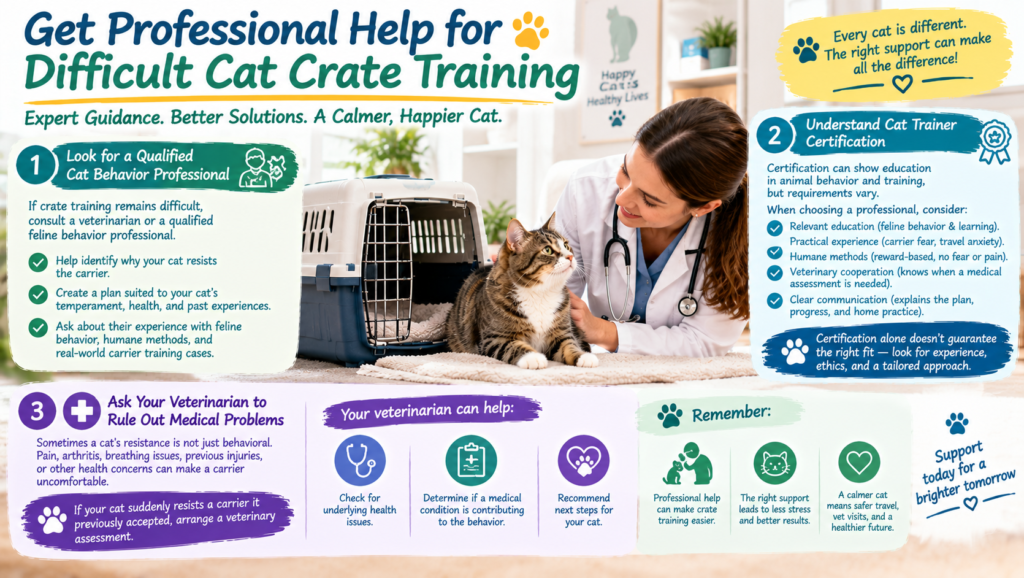
Although many cats can learn to accept a carrier at home, some need additional support. Professional guidance may be especially helpful if your cat has experienced traumatic travel, severe anxiety, or repeated unsuccessful training attempts.
Look for a Qualified Cat Behavior Professional
If crate training remains difficult, consider consulting a veterinarian or a qualified feline behavior professional.
A professional may help you identify why your cat resists the carrier and develop a plan suited to its temperament, health, and previous experiences.
When evaluating a trainer, ask about their experience with feline behavior, humane training methods, and practical carrier-training cases or Crate Training Cats.
Understand Cat Trainer Certification
The phrase cat trainer certification refers to training or credentials that may demonstrate education in animal behavior and training. However, certification requirements and standards vary among organizations.
When choosing a professional, consider:
- Relevant education: Look for knowledge of feline behavior and learning.
- Practical experience: Ask whether the professional has helped cats with carrier fear or travel anxiety.
- Humane methods: Choose someone who emphasizes reward-based training and avoids painful or frightening techniques.
- Veterinary cooperation: A good professional should recognize when a medical assessment is necessary.
- Clear communication: The trainer should explain the plan, expected progress, and how you can continue practicing at home.
Certification alone does not guarantee that a person is the right choice. Look for relevant experience, ethical methods, and an approach tailored to your cat.
Ask Your Veterinarian to Rule Out Medical Problems
Sometimes a cat’s resistance is not simply a behavioral issue. Pain, arthritis, breathing problems, previous injuries, or other health concerns can make entering or remaining in a carrier uncomfortable.
If your cat suddenly begins resisting a carrier it previously accepted, arrange a veterinary assessment.
Your veterinarian can help determine whether a health issue is contributing to the behavior and recommend suitable next steps or Crate Training Cats.
Create a Personalized Training Plan
A professional may recommend breaking training into smaller stages, changing the carrier design, adjusting the home environment, or introducing rewards more strategically.
For example, a fearful cat might initially receive rewards for looking at the carrier from a distance. Later sessions may focus on approaching the entrance, entering voluntarily, and tolerating the door moving.
The pace should depend on your cat’s response rather than a rigid schedule.
With consistency and appropriate support, many cats can become more comfortable with carriers, even if they never enjoy confinement.
Frequently Asked Questions About Crate Training Cats
Can You Crate Train a Cat at Any Age?
Yes. Kittens, adult cats, and senior cats can learn to accept a crate. Kittens may adapt quickly, but older cats can also benefit from gradual, reward-based training or Crate Training Cats.
For senior cats or cats with mobility problems, choose a comfortable carrier that is easy to enter and exit.
Can You Kennel Train a Cat for Long Trips?
Yes, many cats can learn to travel in a carrier, but long journeys require careful planning. Provide appropriate ventilation, temperature control, and opportunities for food, water, and litter-box use as needed or training collar for cats.
Consult your veterinarian before a lengthy trip, particularly if your cat has a medical condition or severe travel anxiety.
How Long Does Cat Crate Training Take?
The time required varies. Some cats become comfortable within a few days, while others need several weeks or longer.
Short, positive sessions are usually more helpful than long sessions that leave your cat frightened. Progress only when your cat is comfortable with the current step or Crate Training Cats.
Is It Safe to Crate a Cat Overnight?
Routine overnight confinement in a small transport carrier is generally not appropriate. Cats need enough space to move comfortably and access essential resources.
If temporary confinement is necessary for recovery or safety, ask your veterinarian what type of enclosure and duration are appropriate for your cat’s individual needs or can you crate train a cat.
Should I Use a Training Collar for Cats?
A training collar is not necessary for crate training. Avoid shock collars, prong collars, and other aversive devices.
Use rewards, familiar bedding, toys, and gradual exposure to help your cat develop a positive association with the carrier.
When Should I Hire a Professional Cat Trainer?
Consider professional help if your cat panics whenever it sees the carrier, becomes aggressive during handling, or repeatedly attempts to escape or Crate Training Cats.
A veterinarian can rule out medical causes, while a qualified feline behavior professional can help develop a suitable training plan.
Conclusion: Can You Crate Train a Cat Successfully?
So, can you crate train a cat successfully? In many cases, yes. The key is to choose an appropriate carrier, introduce it gradually, reward voluntary behavior, and avoid forcing your cat into uncomfortable situations or Crate Training Cats.
The seven methods in this guide provide a practical starting point. Begin by making the crate familiar, use positive reinforcement, and introduce door closing and travel in manageable stages. Avoid aversive tools and seek professional help if your cat experiences significant fear or can you crate train a cat.
Remember that every cat learns at a different pace. With patience, consistency, and attention to your pet’s comfort, crate training can make veterinary visits, travel, and unexpected situations safer and more manageable for both of you.