

 By
7 Tailless Cat Breeds and Their Fascinating History
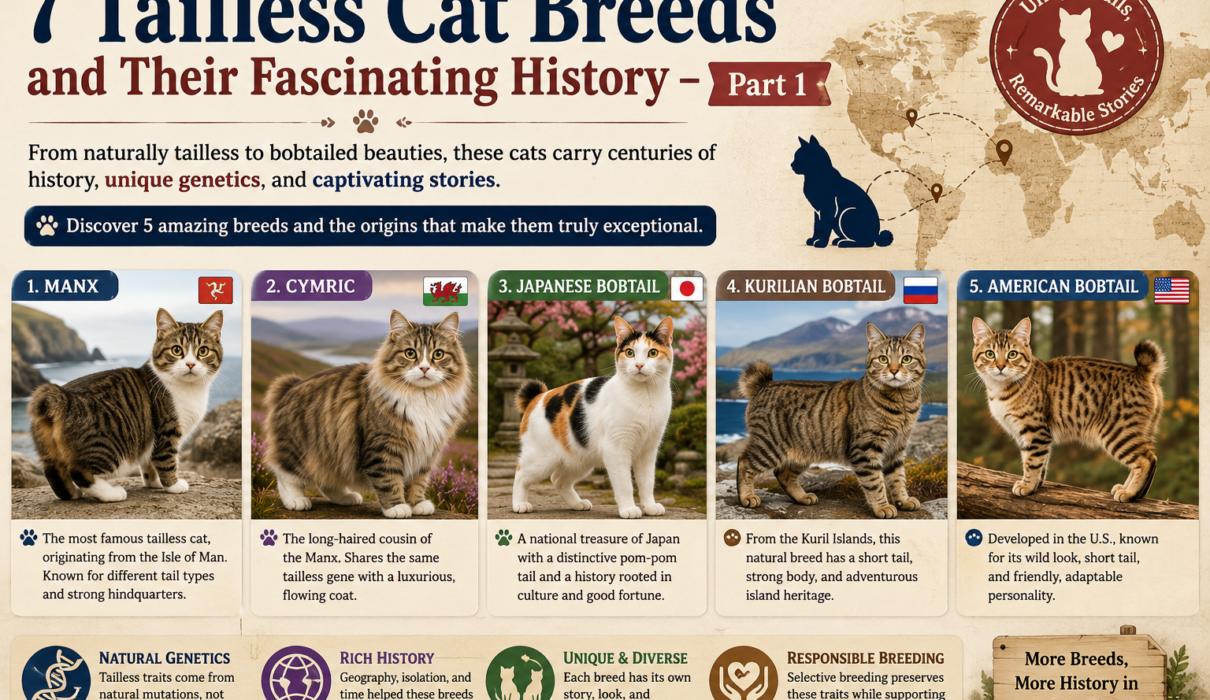
Cats come in an incredible variety of shapes, sizes, colors, and coat types. Among the most unusual are cats with very short tails or no visible tail at all. These distinctive cats have fascinated people for generations, and several have developed into recognized breeds with their own unique histories.
The story behind tailless cat breeds is especially interesting because their unusual tails are often connected to naturally occurring genetic traits rather than hybrid ancestry. Geography, isolated cat populations, and selective breeding have all played a role in shaping these remarkable breeds.
Why Are Some Cats Tailless?
A cat’s tail is an extension of its spine and normally contains a series of vertebrae. In some cats, genetic variations affect the development and length of these vertebrae, resulting in a tail that is unusually short, kinked, or absent.
Taillessness can therefore occur naturally within a cat population. When cats with a particular tail trait reproduce over many generations, that characteristic can become more common in the population.
It is important to understand that a short or absent tail does not automatically mean a cat is a hybrid. A hybrid cat is produced through breeding between different species or, in some cases, closely related wild and domestic cat populations. Many tailless cat breeds developed from domestic cats carrying naturally occurring genetic traits.
The appearance of the tail can also vary considerably. Some cats have no externally visible tail, while others have a small stump, a short curved tail, or a rounded bobtail.
Manx
The Manx is perhaps the most famous of all tailless cat breeds. It is strongly associated with the Isle of Man, an island in the Irish Sea, where cats with naturally shortened tails became well known.
The breed can have different tail lengths. Some Manx cats are completely tailless, while others have a small amount of tail or a more noticeable short tail.
Fascinating History
The Manx has a long history on the Isle of Man. Because the island’s cat population was relatively isolated, the naturally occurring short-tail trait could become established over generations.
The exact origin of the original mutation is not known with certainty. Over time, however, cats carrying the trait became an important part of the island’s feline population.
The Manx eventually became recognized beyond the island and developed into a distinctive breed.
Appearance
Besides its short or absent tail, the Manx is known for a rounded body, strong hindquarters, and a compact appearance. Its hind legs are often longer than its front legs, giving the cat a distinctive stance.
Manx cats can have different coat lengths and come in numerous colors and patterns.
Personality
Manx cats are often described as intelligent, playful, and affectionate. Many enjoy interacting with their human companions and can be active and curious.
As with any breed, individual personalities can vary. A Manx may be outgoing and playful, while another may prefer a quieter environment.
Health Considerations
The same genetic characteristics associated with taillessness can sometimes be linked with spinal or neurological problems in Manx cats. This is one reason responsible breeding and appropriate veterinary care are particularly important.
Anyone considering a Manx should learn about the breed’s health considerations and work with reputable sources that prioritize the welfare of the cats.
Cymric
The Cymric is closely associated with the Manx and is best known for its long, luxurious coat. In simple terms, it can be thought of as the long-haired version of the Manx type.
Like the Manx, Cymrics can have different tail lengths, ranging from no visible tail to a short tail.
Fascinating History
The Cymric’s history is closely connected to the Manx. Long-haired cats carrying the same short-tail characteristics eventually became established as a distinct type.
The name “Cymric” comes from “Cymru,” the Welsh name for Wales, although the breed’s development is closely linked to Manx-type cats rather than originating as an ancient Welsh breed.
Over time, breeders worked to establish the long-haired type as a recognizable breed.
Appearance
The Cymric has a rounded body and a thick, soft coat. Its long fur can make the cat appear especially fluffy and compact.
The absence or shortening of the tail remains one of its most recognizable features.
Personality
Cymrics are commonly described as affectionate, intelligent, and playful. They can form strong relationships with their families and may enjoy interactive games.
Their intelligence can also make them interested in exploring their surroundings and learning through play.
Grooming Needs
The long coat requires more grooming than the short coat of many Manx cats. Regular brushing can help reduce tangles and prevent mats.
Grooming sessions also provide a useful opportunity to check the cat’s skin, ears, and overall condition.
What Makes the Cymric Unique?
The combination of a Manx-type short tail and a long, fluffy coat makes the Cymric stand out among tailless cat breeds.
Japanese Bobtail
The Japanese Bobtail has a long and fascinating association with Japan. Unlike a completely tailless cat, the Japanese Bobtail usually has a distinctive short tail that can resemble a small pom-pom.
The shape and appearance of the tail can vary from one cat to another, making each Japanese Bobtail somewhat unique.
Fascinating History
Short-tailed cats have been associated with Japan for centuries. They have appeared in Japanese art and historical imagery, and bobtailed cats became part of the country’s cultural landscape.
The breed’s short tail is generally understood as a naturally occurring characteristic rather than evidence of hybrid ancestry.
The Japanese Bobtail eventually became known outside Japan as well, and breeders helped establish it as a recognized cat breed.
Appearance
Japanese Bobtails have a slender yet muscular body and distinctive short tails. Their tails may be curved, kinked, or bent, and the fur around the tail can give it a pom-pom-like appearance.
Both short-haired and long-haired varieties are known.
Personality
Japanese Bobtails are often considered active, social, and intelligent cats. They may enjoy interacting with people and can be enthusiastic about play.
Their curious nature means they often benefit from toys, climbing opportunities, and activities that provide mental stimulation.
Cultural Significance
The Japanese Bobtail is particularly interesting because its history is connected not only to cat breeding but also to Japanese culture and art.
Its distinctive tail has helped make the breed recognizable and memorable around the world.
Kurilian Bobtail
The Kurilian Bobtail is another naturally short-tailed cat with an interesting geographical history. It is associated with the Kuril Islands, a chain of islands stretching between northern Japan and Russia.
Its naturally short tail is one of its most distinctive characteristics.
Fascinating History
The Kurilian Bobtail developed in an isolated island environment, where naturally occurring genetic traits could become established within the local cat population.
For generations, these cats lived in the region before gaining wider recognition outside their native area.
The breed’s history is particularly interesting because its short tail is a naturally occurring feature rather than something that was created simply by crossing domestic cats with wild species.
Appearance
Kurilian Bobtails are medium to large cats with strong, muscular bodies. Their tails are short and can have different shapes, including curves and kinks.
Their coats can be short or semi-long and come in a variety of colors and patterns.
Personality
Kurilian Bobtails are often described as intelligent, active, and confident. They can be affectionate with their families while retaining a curious and independent side.
Interactive play and environmental enrichment can help keep these cats mentally and physically engaged.
What Makes the Kurilian Bobtail Unique?
Its combination of ak makes the Kurilian Bobtail particularly fascinating.
American Bobtail
The American Bobtail is a relatively modern breed developed in the United States. It is recognized for its naturally short tail and sturdy body.
Although its appearance can sometimes remind people of a wild cat, its distinctive tail does not mean that it is a wild-cat hybrid.
Fascinating History
The American Bobtail developed through domestic cat breeding in the United States. Cats with naturally short tails were used in the development of the breed, and breeders worked to establish consistent physical and personality characteristics.
Over time, the American Bobtail became recognized as a distinct domestic breed.
Its wild-looking appearance has contributed to some myths about its ancestry, but unusual markings or a short tail alone do not establish wild-cat ancestry.
Appearance
American Bobtails have a substantial, muscular appearance and a noticeably short tail. Their coats can be short or long and may come in many colors and patterns.
The tail can vary in shape and length, which adds to the breed’s individual character.
Personality
American Bobtails are often described as friendly, adaptable, and playful. They can make engaging companions and may adjust well to different household environments.
Their curious nature means they can benefit from interactive toys and regular play.
What Makes the American Bobtail Unique?
The breed combines a short natural tail with a sturdy body and wild-looking appearance, making it one of the most recognizable modern tailless cat breeds—although technically, many American Bobtails are bobtailed rather than completely tailless.
Tailless vs. Bobtail Cats
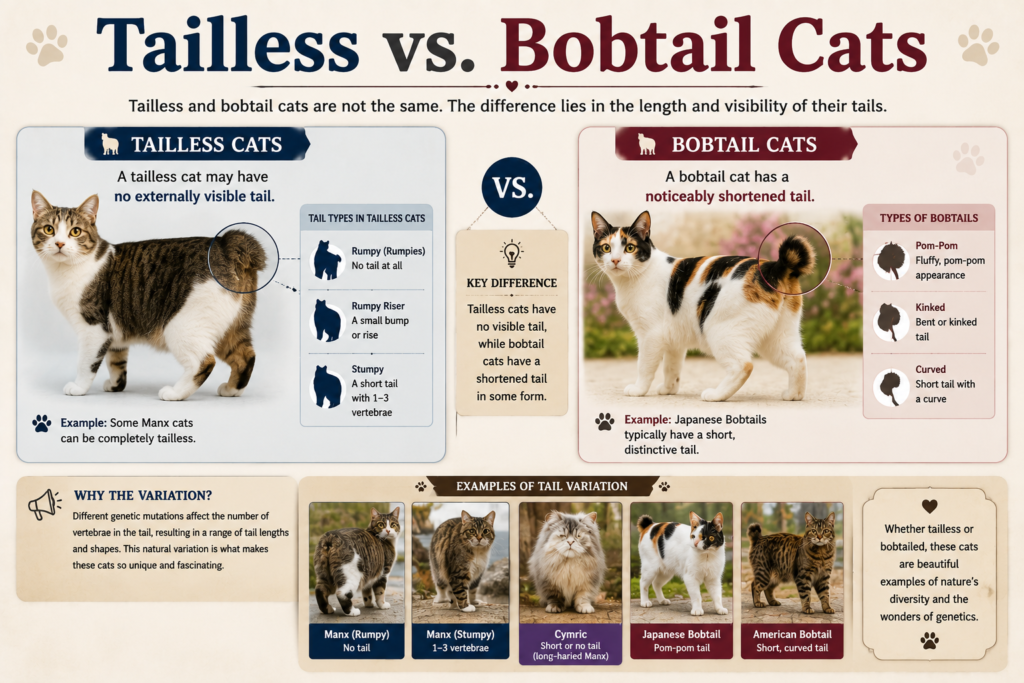
Learn the key differences between tailless and bobtail cats, from completely absent tails to short, curved, or kinked tailsOne important point is that “tailless” and “bobtail” do not always mean exactly the same thing.
A tailless cat may have no externally visible tail, while a bobtail cat generally has a noticeably shortened tail. Some bobtails may have only a few vertebrae, while others have a small curved or kinked tail.
For example, some Manx cats can be completely tailless, whereas Japanese Bobtails typically have a short, distinctive tail.
This variation is part of what makes these cats so fascinating.
Are Tailless Cats Hybrid Cat Breeds?
A common misconception is that cats with unusual tails must be related to wild cats. In reality, a naturally short or absent tail can result from a genetic variation within domestic cat populations.
A hybrid cat breed has a different meaning. Hybrid cats are generally developed through crosses involving domestic cats and another feline species or wild cat lineage.
Therefore, the presence of a short tail alone is not evidence that a cat is a hybrid.
Responsible breeders also need to distinguish between preserving a naturally occurring trait and creating a hybrid through intentional crossing.
Final Thoughts on Part 1
The history of tailless cat breeds is a fascinating combination of genetics, geography, culture, and breeding. The Manx became famous on the Isle of Man, while the Cymric developed as a long-haired Manx type. The Japanese Bobtail has deep cultural connections to Japan, the Kurilian Bobtail developed around the Kuril Islands, and the American Bobtail emerged as a modern American breed.
These cats demonstrate how naturally occurring genetic traits can become important characteristics of domestic cat populations.
In Part 2, we’ll explore the Mekong Bobtail and Pixiebob before looking more closely at selective breeding, health considerations, hybrid-cat myths, and the differences between tailless and bobtailed cats.
7 Tailless Cat Breeds and Their Fascinating History
In Part 1, we explored the fascinating history of five distinctive tailless cat breeds and bobtail cats: the Manx, Cymric, Japanese Bobtail, Kurilian Bobtail, and American Bobtail.
These breeds showed how naturally occurring genetic traits, geography, culture, and responsible breeding can influence the development of domestic cats. In Part 2, we’ll continue with two more fascinating breeds—the Mekong Bobtail and Pixiebob—and then explore hybrid myths, selective breeding, health, and personality.
Mekong Bobtail
The Mekong Bobtail is a distinctive short-tailed cat associated with Southeast Asia. Its most recognizable feature is its short, kinked or curved tail.
Unlike cats with completely absent tails, Mekong Bobtails usually have a visible but shortened tail. The shape can vary between individual cats, making the tail an important part of their unique appearance.
Fascinating History
The Mekong Bobtail has historical associations with countries in Southeast Asia. Short-tailed cats have been known in the region for generations, and naturally occurring tail variations contributed to the development of the breed.
The breed later attracted attention beyond Southeast Asia, and dedicated breeding programs helped establish consistent characteristics.
Its history is particularly interesting because its distinctive tail is not simply a result of creating a modern hybrid. Instead, the short-tail trait became an important feature of a domestic cat population.
Appearance
Mekong Bobtails are known for their color-point coats, which can resemble the pattern seen in Siamese-type cats. They typically have blue eyes and a lighter body with darker coloring on the face, ears, legs, and tail.
Their short, kinked tails make them easy to distinguish from many other cats.
Personality
Mekong Bobtails are often described as active, social, and affectionate. They may enjoy interacting with people and can be playful companions.
Because they can be curious and energetic, interactive toys and regular play sessions can provide useful physical and mental stimulation.
What Makes the Mekong Bobtail Unique?
The breed combines a short, kinked tail, color-point coat, and blue eyes. These features give the Mekong Bobtail a distinctive appearance among short-tailed domestic cats.
Pixiebob
The Pixiebob is an American breed recognized for its short tail and wild-looking appearance. Its sturdy body, spotted coat, and facial features can give it a somewhat wild appearance.
Despite its name and appearance, the Pixiebob is considered a domestic cat breed.
Fascinating History
The Pixiebob was developed in the United States during the late twentieth century. The breed’s history includes cats with naturally short tails and breeders who worked to establish a consistent type.
The breed became particularly interesting because of its resemblance to certain wild cats. This led to stories and speculation about wild-cat ancestry.
However, appearance alone does not prove that a domestic cat has wild ancestry. Breed history and documented breeding records are more reliable than visual similarities.
Appearance
Pixiebobs generally have a muscular body, a broad head, and a short tail. Their coats can have spotted or patterned markings that contribute to their wild-looking appearance.
Some individuals may also have extra toes, a feature sometimes associated with the breed.
Personality
Pixiebobs are often described as intelligent, social, and devoted to their families. Many enjoy interactive play and human companionship.
Their curious nature can make puzzle toys and enrichment activities particularly useful.
What Makes the Pixiebob Unique?
Its combination of a short tail, sturdy build, spotted appearance, and domestic temperament makes the Pixiebob one of the most distinctive modern bobtail breeds.
Are Tailless Cats Hybrid Cat Breeds?
One of the most common questions about unusual-looking cats is whether they are hybrids.
The answer is generally no. A cat does not become a hybrid simply because it has no tail, a short tail, unusual markings, or a wild-looking appearance.
A hybrid involves ancestry from different feline species or from domestic cats and certain wild feline species. For example, some recognized hybrid cat breeds have been developed through crosses involving domestic cats and wild cat species.
In contrast, many tailless cat breeds developed from naturally occurring genetic traits within domestic cat populations.
This distinction is important because the appearance of a cat cannot reliably tell you its genetic history.
Cat Hybrids Breeds vs. Tailless Breeds
The terms cat hybrids breeds and tailless breeds should not be used interchangeably.
Tailless or bobtailed cats are defined primarily by their tail characteristics. Their short tails can result from naturally occurring genetic variations.
Hybrid cats, on the other hand, have ancestry involving different feline species or specific wild-cat crosses.
Therefore, a Manx, Japanese Bobtail, or American Bobtail should not automatically be considered a hybrid simply because its tail looks unusual.
Tailless Cats and Selective Breeding
Selective breeding has played an important role in turning naturally occurring traits into recognized cat breeds.
When a naturally short-tailed cat has desirable characteristics, breeders may carefully select cats with similar traits for future generations. Over time, this can help establish a consistent breed type.
This process is an example of selective breeding cat species, although the more accurate term in domestic-cat breeding is selective breeding within domestic cat populations.
Responsible breeding should involve much more than selecting cats for unusual physical features. Breeders should also consider temperament, genetic diversity, overall health, and the welfare of the cats.
Why Responsible Breeding Matters
Some genetic traits can be associated with health concerns. This means breeders should avoid focusing solely on producing an unusual appearance.
Health testing, appropriate breeding choices, veterinary care, and maintaining genetic diversity can all help support healthier cat populations.
Potential owners should ask breeders about health screening, breeding practices, and the health history of the parents.
Are Tailless Cats Healthy?
Tailless cats can be healthy, but health varies between breeds and individual animals.
The genetic factors responsible for unusual tails can have different effects depending on the breed. This is especially important with Manx cats, where certain forms of the tailless trait can be associated with spinal and neurological problems.
This does not mean that every tailless cat will develop health problems. Instead, it highlights the importance of responsible breeding and veterinary monitoring.
Keeping a Tailless Cat Healthy
Owners can support their cat’s general health by providing:
A balanced, age-appropriate diet
Regular veterinary examinations
Appropriate exercise and play
Healthy weight management
Good dental care
A safe and stimulating home environment
If a cat shows difficulty walking, unusual movement, weakness, pain, or changes in bathroom habits, veterinary attention is important.
Do Tailless Cats Have Different Personalities?
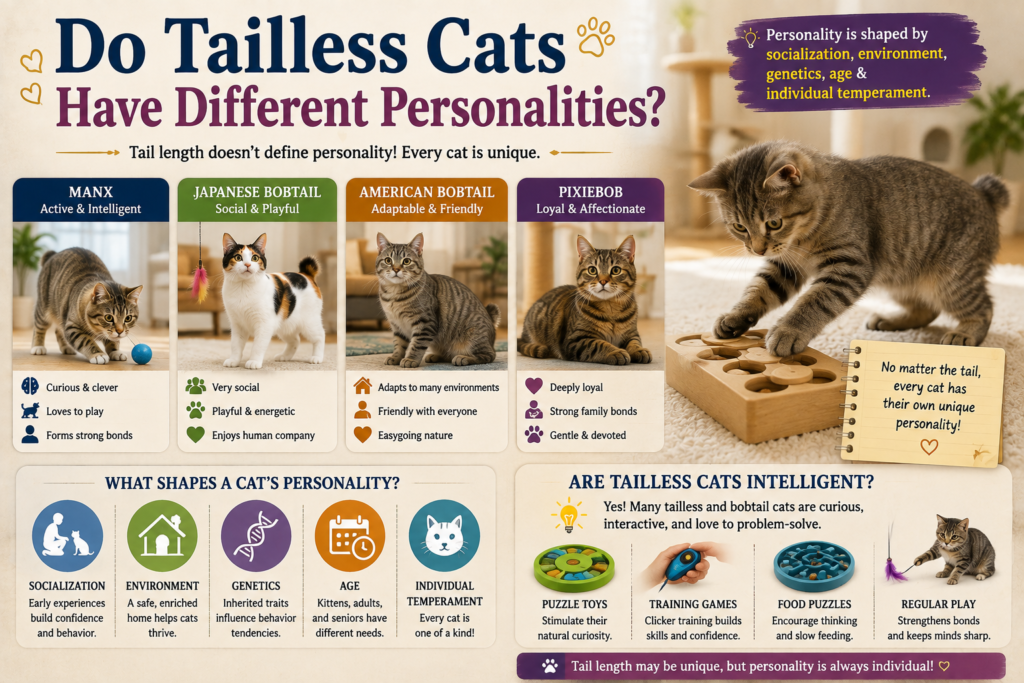
Discover the unique personalities and intelligence of tailless and bobtail cats.There is no single personality shared by all tailless cat breeds.
The Manx may be active and intelligent, while the Japanese Bobtail can be social and playful. The American Bobtail is often described as adaptable, while the Pixiebob may form strong bonds with its family.
These differences demonstrate why breed can provide useful clues but cannot completely predict an individual cat’s personality.
Socialization, environment, genetics, age, and individual temperament can all influence how a cat behaves.
Are Tailless Cats Intelligent?
Many tailless and bobtail cats are curious and interactive. They may enjoy puzzle toys, training games, and activities that encourage problem-solving.
However, intelligence is not determined by tail length. A cat’s ability to learn and interact with its environment varies from one individual to another.
Owners can encourage mental stimulation through interactive toys, food puzzles, clicker-style training, and regular play.
Tailless Cats vs. Bobtail Cats
Although the terms are sometimes used interchangeably, there is a useful distinction:
Tailless cats:
These cats may have no externally visible tail.
Bobtail cats:
These cats generally have a noticeably shortened tail that may be curved, kinked, or rounded.
Some breeds can have multiple tail types. The Manx, for example, can range from completely tailless individuals to cats with short or more developed tails.
Japanese Bobtails and Mekong Bobtails are generally better described as bobtail breeds because they typically retain a small tail.
What Makes Tailless Cat Breeds So Fascinating?
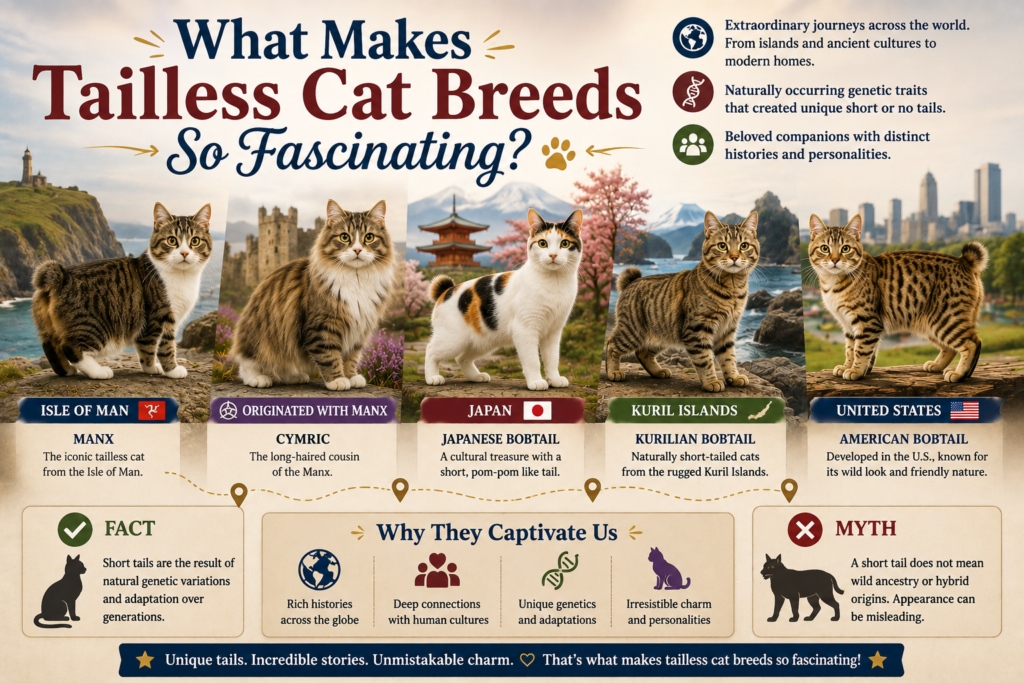
demonstrate how cats adapted to different environments and how naturally occurring genetic traits became established The appeal of tailless cat breeds goes beyond their unusual appearance. Their histories in isolated populations.
From the Isle of Man to Japan, the Kuril Islands, Southeast Asia, and the United States, these cats have developed connections to different cultures and regions.
Their stories also show why it is important to separate fact from popular myths. A short tail does not automatically indicate wild ancestry or hybrid origins.
Frequently Asked Questions
What is the most famous tailless cat breed?
The Manx is arguably the most famous naturally tailless cat breed. It is strongly associated with the Isle of Man and is known for its range of tail types.
Which cat breeds are naturally tailless?
The Manx is particularly well known for naturally occurring taillessness. Other breeds, including bobtail breeds, have naturally shortened tails rather than complete absence of a tail.
Are tailless cats born without tails?
Some are. Depending on the breed and genetics, a cat may be born with no externally visible tail, a small stump, or a short and sometimes kinked tail.
Are tailless cats healthy?
Many can live healthy lives, but health considerations vary by breed. Some genetic traits associated with taillessness can be linked with health concerns, making responsible breeding and regular veterinary care important.
Is the Manx completely tailless?
Not every Manx is completely tailless. Manx cats can have different tail lengths, ranging from no visible tail to a short or more developed tail.
What is the difference between a bobtail and a tailless cat?
A tailless cat has little or no externally visible tail, while a bobtail generally has a shortened tail that remains visible.
Are tailless cats hybrid cat breeds?
Not necessarily. Many tailless cat breeds developed from naturally occurring genetic traits within domestic cat populations. A short tail alone does not indicate hybrid ancestry.
Are Japanese Bobtails naturally tailless?
Japanese Bobtails typically have naturally short tails rather than being completely tailless. Their tails can have distinctive curves, bends, or a pom-pom-like appearance.
Which tailless cat breed has the longest history?
The Manx and Japanese Bobtail both have long historical associations with their regions. The Manx is especially well known for its long-standing connection with the Isle of Man, while short-tailed cats have been documented in Japan for centuries.
Conclusion
The history of tailless cat breeds is filled with fascinating stories about genetics, geography, culture, and selective breeding. The Mekong Bobtail stands out for its color-point coat and kinked tail, while the Pixiebob combines a short tail with a sturdy, wild-looking appearance.
These cats also demonstrate why an unusual appearance does not automatically mean a cat is a hybrid. Many short-tailed and tailless cats developed from naturally occurring genetic traits within domestic cat populations.
Whether you’re interested in the history of the Manx, the cultural connection of the Japanese Bobtail, or the unusual appearance of modern bobtail breeds, each cat has a unique story.
Most importantly, anyone considering one of these breeds should look beyond appearance. Responsible breeding, good nutrition, regular veterinary care, appropriate exercise, and a loving home are key to helping any cat live a healthy and fulfilling life.
1 Comment