Numerous symbols represent the American West, but few are more inspiring than the image of a wild Mustang horse on the move. These horses are more than just game; they are historical treasures.
Though Mustangs are referred to as “wild”, they are technically “feral”. That is, they are the descendants of domesticated horses. Their tale from European stables to the open plains of North America is one of survival and evolution.
One of the most striking colours among those that roam the plains is black. A black Mustang is a rare creature, shrouded in mystery and allure. Here, we’ll explore the history of these creatures and the genetics behind their most desirable traits.
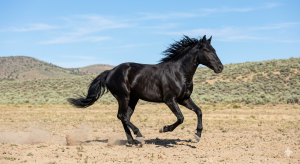
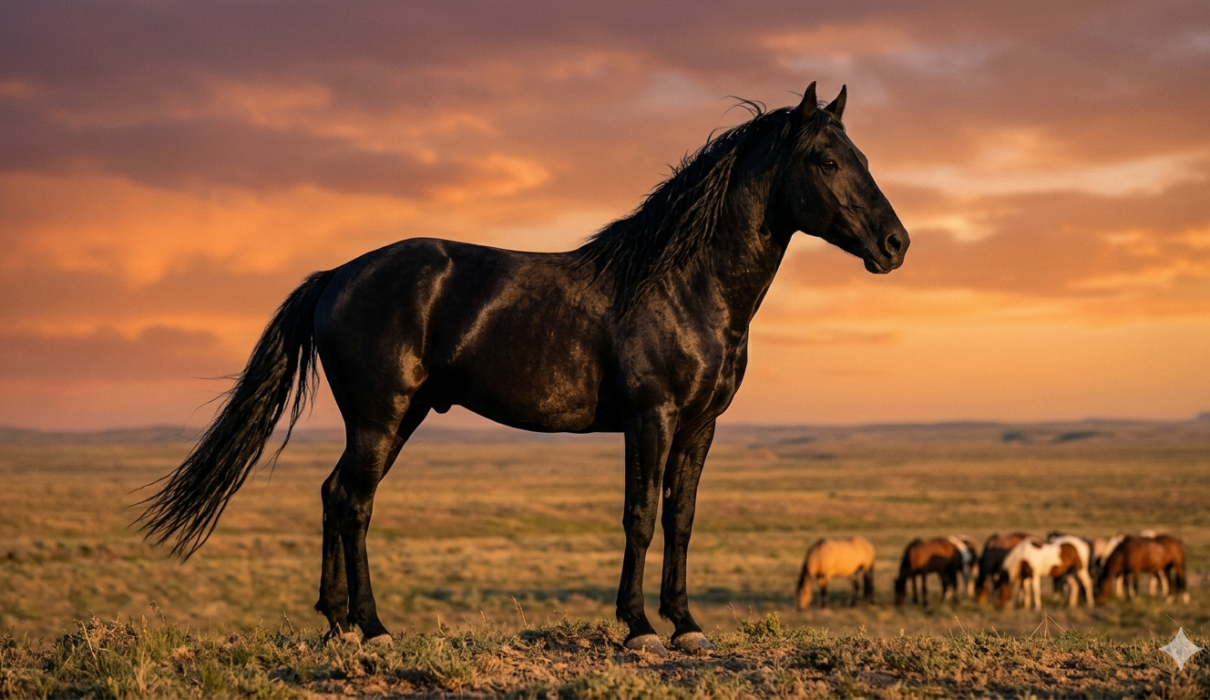
A powerful, jet-black Mustang stallion galloping across the open plains, embodying the “Wild Beauty” of the American West.
A Spanish Heritage
The Mustang’s origins go back to the 16th century. Explorers from Spain, the Conquistadors, took their finest horses from Iberia to the New World. Horses had been extinct in the Americas for thousands of years.
These horses were a combination of Barb, Arabian and Andalusian stock. They were known for their strength, cunning and “cow sense.” Many of these horses escaped or were sold, laying the groundwork for today’s feral populations.
The term “Mustang” is derived from mesteño. It means “stray” or “ownerless” cattle. It’s a fitting term for a horse that’s free to answer only to the seasons.
The Allure of the Black Mustang
Color can be important for the survival of wild horses. Most Mustangs are “earth-toned” dun, bay or chestnut to camouflage into the arid vegetation and canyon rocks. The all-black horse is therefore a rare sight.
The black Mustang is a rare and coveted adoption and photograph. There is something romantic about seeing a black stallion charge in front of a herd of horses. In some tribes, a black horse was considered a symbol of power and a storm horse.
But being black in the wild can be a challenge. The sunny days of the American plains tend to “sun-bleach” the hair. This can turn a black horse brownish-red, or “fading black”.
The Genetics of Rare Coats
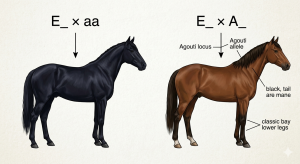
What makes a horse black? It has to do with a gene known as the Extension gene. A horse needs to have at least one dominant “E” allele at the Extension gene and two recessive “a” alleles at the Agouti gene for it to be black.
When the Agouti gene is dominant, black pigmentation is limited to the mane, tail, and legs, forming a “Bay” horse. When both genes are present, the result is the rare midnight black coat of the most famous wild stallions.
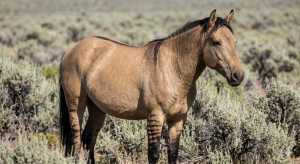
And collectors seek out rare horse breeds in the Mustang herd. Some herds are so isolated that they retain a high frequency of “primitive” Spanish traits. Markers include zebra stripes on the legs and a stripe along the back.
This comparative diagram illustrates how the Agouti gene (A) modifies the Extension gene (E). A horse with the ‘aa’ combination results in a solid black horse, while the dominant ‘A’ gene restricts black to the points, creating a bay.
Life on the Open Plains
Life for the Mustang horse can be a fight for survival. They inhabit some of North America’s harshest habitats. They live in the high deserts of Nevada and on the high mountain tops of Wyoming.
Mustangs have iron-hard hoofs. This enables them to cover long distances over sharp rocks to find water. They also have highly efficient digestive tracts, which help them to get sustenance from tough, dry shrubs.
Their survival is made possible by their social structure. The herd is usually headed up by a “lead mare”. She will lead the way, determining when and where to graze. The stallion’s role is to defend the rear from mountain lions and other bachelors.
Why Preservation Matters
The Mustang is now protected under the Wild Free-Roaming Horses and Burros Act of 1971. They are “living symbols of the historic and pioneer spirit of the West”.
Protecting these herds is about more than preserving a beautiful creature. It is about preserving the genetic heritage of rare horse breeds. Each HMA (Herd Management Area) provides a different “time capsule”.
Part 2: The Rare Spanish Herds and The “First Three”
There are many Mustang herds in the West, but a couple are known to be rich in Spanish blood. These are often the ones with the most exotic colours and the typical “Baroque” conformation.
1. The Kiger Mustang (The Spanish Treasure of Oregon)
The Kiger Mustang is probably the most well-known wild horse. They were found in 1977 during a roundup in Oregon. A small band of horses stood out due to their striking resemblance to each other and their differences from other horses.
They had big eyes, small hooked ears, and were muscular and compact. And DNA testing verified they were the descendants of Spanish Colonial horses. The Bureau of Land Management (BLM) quickly relocated them to preserve their purity.
Although Kigers are most often a “dun” color, they also come in beautiful dark blacks. Black Kiger Mustangs are breathtaking, and often have a strong, wavy mane and noble, “crested” neck, giving them the appearance of royalty.
A close-up of a Kiger Mustang displaying distinct primitive Spanish markers: a dark dorsal stripe and faint tiger striping on the knees.
2. The Pryor Mountain Mustang (The Warriors of Montana)
Way up in the wild mountains of Montana and Wyoming, there are a herd that has been there since the 18th century. The Pryor Mountain Mustangs are believed to have been brought in by local tribes, such as the Crow.
These Mustangs are smaller than the typical Mustang, but they are extremely muscular. They have thick bones and are extremely hardy. They are adapted to live at high altitudes, so their winter coats are particularly thick.
You can find just about every rare coat color in this herd. This includes the “blue roan” – a black horse with white hairs intermingled – and solid black stallions. Over the centuries, their “Spanish” appearance has been preserved due to their isolation.
3. Sulphur Springs Mustang (The Primitive Relic)
The Sulphur Springs Mustangs, in the Needle Range of Utah, are literally a glimpse back in time. These horses are considered to be the “purest” Spanish horses remaining.
Their “primitive” look is what makes them unique. They look like the horses in 16th-century Spanish paintings. They are narrow-chested, have “Roman” noses and sloping croups.
Although Sulphur Mustangs are often “Grulla” (a mouse-grey shade of black), solid black ones are prized. These horses are identified by a genetic marker that originated on the Iberian Peninsula, and are a “biological time capsule” for horse enthusiasts and historians.
The Importance of Genetic Isolation
Why are these three herds important? During the 19th century, many feral herds were “contaminated” by runaway workhorses, farmhorses, and cavalry horses. This altered their physical appearance and their genetics.
The Kiger, Pryor and Sulphur herds were protected because of their location. They were isolated in canyons or on mountain tops, inaccessible to other horses. This kept them protected and their unique traits and “black beauty” genetics alive
Part 3: The Superstars and Super Stallions
The next six varieties are some of the most attractive and well-known Mustang herds in the world. In this article, we consider the very rare occurrence of the black horse in these multicoloured populations.
4. Steens Mountain Black Beauty (Oregon)
Oregon’s Steens Mountain HMA is home to some of the largest Mustangs in the United States. The harsh living conditions at high altitude have bred a large, muscular horse.
Although the herd is maintained for a variety of pinto patterns, the solid black Mustangs from this area are famous. Steens Mountain black stallions are sometimes larger than other Mustangs, at 15 to 16 hands high. They stand out beautifully against the rocky backdrop of the Steens Mountain loop.
5. McCullough Peaks Celebrity Stallions (Wyoming)
The McCullough Peaks herd, near Cody, Wyoming, is famous for its good health and brilliant colouration. Here, “celebrity” stallions are found roaming the desert.
This herd comprises a rainbow of coat colors, including blue roans, pintos and shiny dark blacks. These horses can be larger and “fancier” than those in other feral populations. Their black stallions are especially renowned for their shiny coats, which stand out against the colorful badlands and red, painted mountains of Wyoming.
6. The Sand Wash Basin (Colorado’s High Desert)
Sand Wash Basin is one of America’s most famous Mustang herds. The Mustangs gallop on the open sagebrush plains like the most dramatic Western movie.
The basin is best known for the herd’s late founder stallion “Picasso”, and his varicolored offspring, but the rare black Mustangs are also fascinating. The black Mustangs are adapted to a dry environment. The sight of a black horse in the golden glow of a Colorado sunset is a “must-see” for horse lovers.
7. Onaqui Mountain (Salt Flats of Utah)
The Onaqui herd in Utah is probably the most photographed herd of wild horses. The horses are very used to humans, making for close (but respectful) observations.
In the 1990s, some Wyoming horses were added to the herd, adding to the diversity of coat colours, including solid black. The contrast of a black Onaqui stallion running across the white salt flats of Skull Valley is a beautiful sight to behold. They are an example of how genetic diversity can lead to a healthy, beautiful population.
8. The Piceance-East Douglas (Colorado’s Genetic Mix)
The Piceance-East Douglas herd in northwest Colorado has horses that look like a sound Quarter Horse. These horses are known for being easy to handle and train.
Colours here tend to be blue, gray and black. Given their sometimes stockier bodies, the black horses have a “workhorse” appearance, with muscularity and strength. This herd is a strong focus for efforts to maintain the genetic integrity of Colorado’s wild horses.
9. Virginia Range (The “Wild Horse Annie” Herd)
The Virginia Range Mustangs are in the Northern part of Nevada. They were the inspiration for “Wild Horse Annie” to successfully argue for federal protection of all wild horses in the 1950s.
The Virginia Range is rugged, with many rocks, and the horses are highly agile. Black Mustangs can be seen roaming the canyons and brush. They are an emblem of the “pioneer spirit” and are still thriving on the outskirts of human civilisation.
Part 4: Socialisation, survival and the future of the Mustang
The true beauty of a Mustang is in the eye of the beholder. We may marvel at the rare colour of a black stallion or the ancient heritage of a Kiger, but they are valuable for their adaptability. Part 4 looks at how they cope with the social and environmental challenges of the American West.
The Social Architecture of the Herd
The Mustang herd is not a mob, but a social community. The alpha mare is at the centre of each band. It is the mare who is the decision-maker, not the stallion, who is the most prominent. She knows when to move the herd to water, where the best pasture is, and when the herd must flee from a potential danger.
The stallion is a protector and guardian. In herds with a black horse stallion, his colour may be a liability in the summer months, but it is a formidable sight to other males. The stallion’s role is to “snake” the mares, holding them close and chasing away other males that attempt to take the mares away from him. This keeps the genetic material of the most fit and healthy horses in the gene pool for future generations.
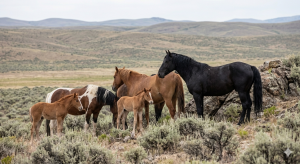
A functioning social band in the high desert. A dominant Mustang horse stallion watches over his mares and foals, illustrating the band dynamics required for survival.
Survival in the Extremes
Mustangs live in some of the “marginal” regions of North America, places that are often too arid or too steep for cattle or sheep. They’ve adapted to survive in these environments. In the harsh winters of Wyoming or Montana, Mustangs will develop woolly coats. Black horses in winter are not the same as in summer, as they retain heat and insulate their skin against wind.
When water is scarce due to cold weather, Mustangs have been reported to kick through ice. During a drought, they can gallop more than 20 miles a day to find grass and water. This is what makes the “Mustang” breed so resilient. The wild Mustang is a self-sustaining marvel, unlike “domesticated” horses.
The Science of Population Management
With few natural predators in the wild (except in areas where mountain lions are present), the Mustang population grows by 100% every 4 to 5 years. The Bureau of Land Management (BLM) is left to manage this difficult situation. If the population gets too high, it can reach the “Appropriate Management Level” (AML), leading to overgrazing, starving horses, and ecosystem issues.
To address this, the BLM conducts roundups, sometimes using helicopters to herd animals into corrals. The horses are then made available for adoption. Horse lovers often target unique horse breeds or certain equine colours, particularly horses with a black coat, at these adoptions. In recent times, there has been an effort to adopt more humane management practices, such as using PZP (a fertility vaccine) to reduce the number of horses without removing them from their habitat.
The “Black Beauty” Symbolism in Conservation
Black horses have always been good for conservation. The “ambassador horses,” such as “Raven” or “Midnight”, help the public identify with the wild herds. And if you can get people to see a beautiful black stallion defending his herd, they are more inclined to vote for land preservation.
But conservation is more than preserving the “pretty” horses. It’s about saving the whole ecosystem of the Great Basin and the Red Desert. By protecting the Mustang, we are also protecting the habitat for sage-grouse, pronghorn antelope and a host of other species.
How to Support the Wild Mustang
If you’re inspired by the “9 Wild Mustangs” in this article, here are some things you can do.
Responsible Tourism: Visit Herd Management Areas (HMAs) and observe the horses. Take photos with a long lens and don’t approach or feed wild horses.
Adoption: If you have the time and experience, adopting a Mustang from a BLM holding facility is a wonderful thing to do. They make an excellent companion and are “iron” healthy.
Advocacy: Get involved with groups working for sustainable on-range management and the preservation of the 1971 Wild Free-Roaming Horses and Burros Act.
Conclusion: A Legacy Worth Protecting
The Mustang horse is a connection to the past. From the Spanish horses of the 1500s to the mighty black stallions of today’s Steens Mountain, these horses symbolize resilience. They symbolise an era when the sky was vast, and the land was free.
From the rare Kiger to the rugged Pryor Mountain pony, to the dark beauty of the Utah desert, each Mustang is a joy. Through knowledge, respect and protection of their environment, the wild spirit of the Mustang shall go on to echo through the wind and the prairies for ages to come. The “Wild West” may be gone, but the spirit of the Mustang lives on.


 By